London: Ryoji Ikeda π, e, ø @Almine Rech

Japan’s leading electronic composer and visual artist Ryoji Ikeda is currently showing  a solo exhibition ‘ π, e, ø,’ organised with Olivier Renaud-Clement at Almine Rech Gallery in London

Ryoji Ikeda has gained a reputation as a unique artist working across both visual and sonic media. He elaborately orchestrates sound, visual materials, physical phenomena and mathematical notions into immersive live performances and installations.

The exhibition title π, e, ø stands for three important mathematical constants;

π (pi, the ratio of a circle’s circumference to its diameter)
e (the base of the natural logarithm)
ø (phi, golden ratio: a+b/a = a/b), all of which are infinite.
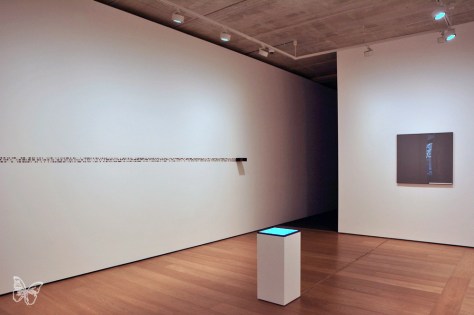
The show focuses on the essential characteristics of sound itself and that of visuals as light by means of both mathematical precision and aesthetics.
Through the use of mathematical vocabulary, the artist seeks to present infinity in a visual way.
The works on paper,  multiple variations of 1×1 surfaces of white and black from series of numbers,  the transcendental and the irrational, are exhaustively visualised in decimal expressions reaching 1.25 million digits a piece. These signs are beyond the limits of human comprehension or experience, and must be taken for wonders — apparitions of ominous and numinous beauty. A restrained elegance and minimalism reigns throughout, but the monochromatic surfaces belie the furious richness and staggering detail within.
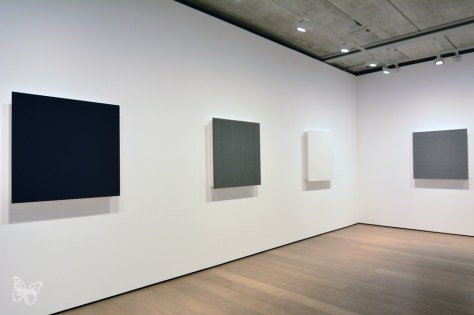
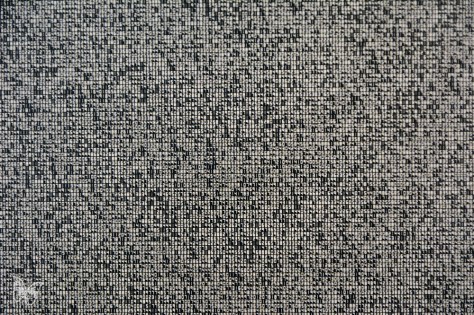
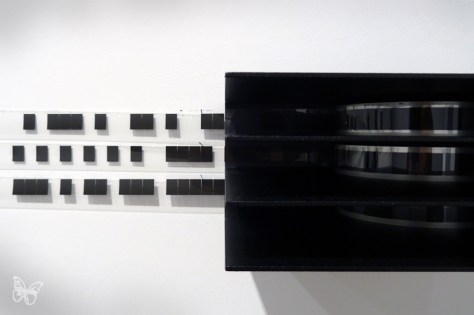
Works from Ryoji Ikeda’s time and space series,  which convert the notion of Time onto 2-dimensional surfaces (Space), are presented together with works from the test pattern series that refers to the mathematical constants π, e, ø  and uses colors which are developed during the colour separation process of 16mm film.
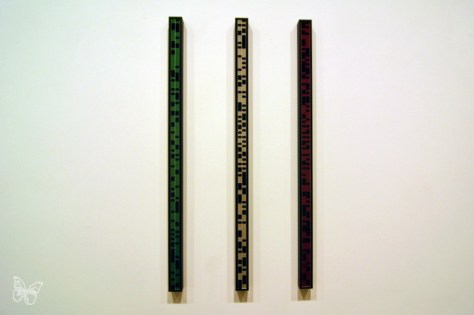
More silent epiphanies are present in related works that elegantly visualise silence and time. 0’10” shows the numerical countdown from 10 to 0 that precedes films, making physically manifest the immaterial and temporal notion of ten seconds of 16mm film. Similarly, the work 4’33’, which consists of the physical equivalent of four minutes and thirty-three seconds of blank 16mm film with time code, clearly references John Cage’s hugely philosophical meditation on the impossibility of silence.
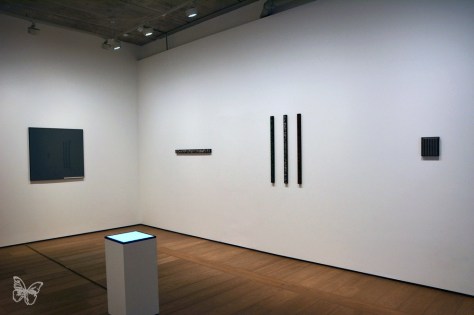
data.scan [nº1-9] is part of Ryoji Ikeda’s ongoing datamatics project (2006-) in which he explores the potential to perceive the invisible multi-substance of data which permeates our world. It is a series of experiments in various forms – audiovisual concerts, installations, publications and CD releases – that seek to materialise pure data. The audiovisual installations are composed of a combination of mathematics and the vast sea of data present in the world. Elaborately composed microscopic visualisations are shown on nine displays on plinths, all tightly synchronised with a minimal soundtrack and features sets of data from recent meta-scientific investigations mapping the human body and the astronomical universe (structures of errors, DNA sequence | chromosome nº11, morse code studies, molecular structure | protein, 4-dimensional hypercube | nodes). Positioned horizontally in intimate relation to the viewer’s body, the installation offers an intimate perception of each singular data investigation.

Echoing data.scan installation, is an ambiguous archeology of encoded knowledge from the systematics series.  Systematic patterns of data expression, from archival computer formats to contemporary technology referring to the technological progress of the digital age are displayed. These “primitive” systems, cultural artifacts and remnants of earlier technologies belong to a technological continuum beginning with the earliest stirrings of coded communication. The memory of a song forgotten in the piano roll, is now only silence, absence.
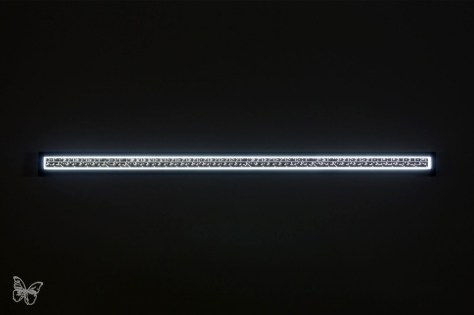
Ryoji Ikeda π, e, ø
Until 20 May
Almine Rech Gallery, London
Grosvenor Hill, Broadbent House,
W1K 3JH London UK


Streets: Banksy Brexit mural in Dover

Banksy in Dover

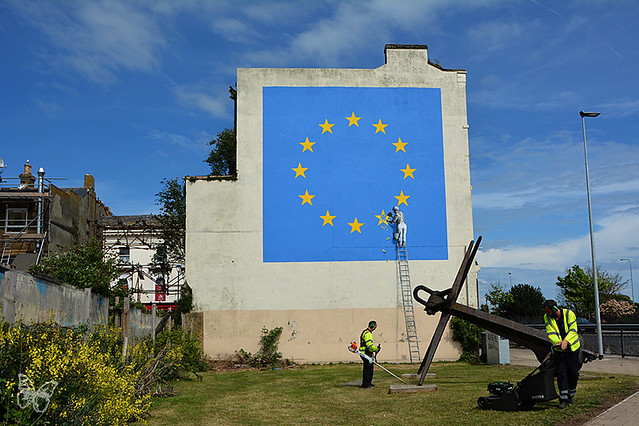
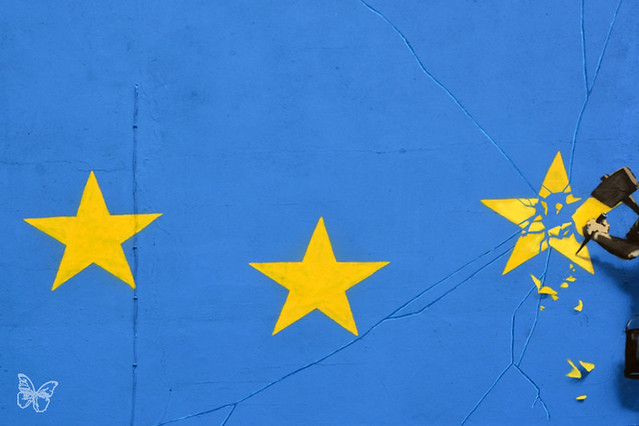
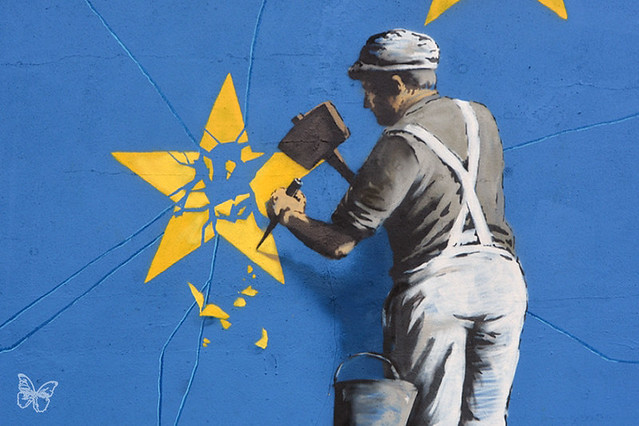
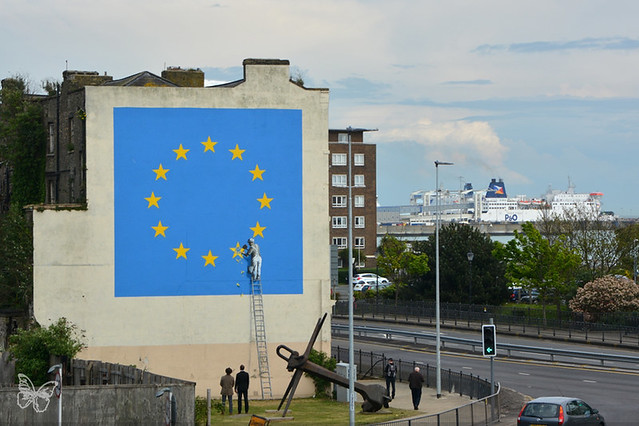
When Banksy confirmed on Instagram a new mural in Dover last Sunday, it created an internet frenzy (covered).  We popped by to have a closer look at the biggest unauthorised work by the elusive artist in the UK .

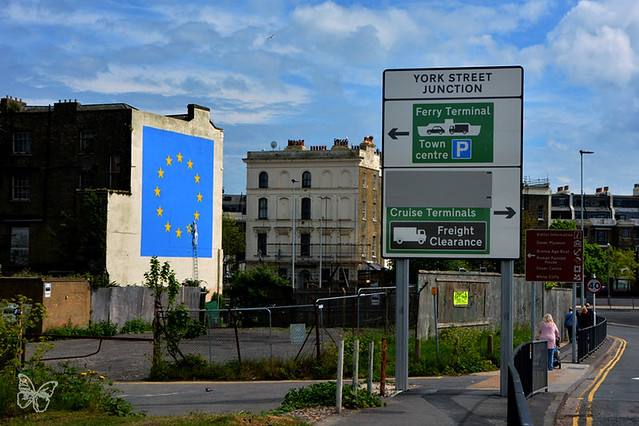
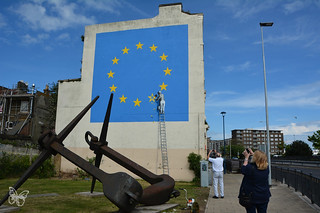
As usual with the artist, location and message are key. Dover being a strategic location as a ferry port in South East England, and first port of entry and link between the UK and Europe. The mural has been painted on a building of a disused amusement arcade, at a crossing junction between York Street and the A20,where all the lorries drive by to the ferry port, while a large derelict sign ‘Welcome to Dover’ greets trucks on their way in.

Banksy in DoverBanksy in DoverBanksy in DoverBanksy in Dover

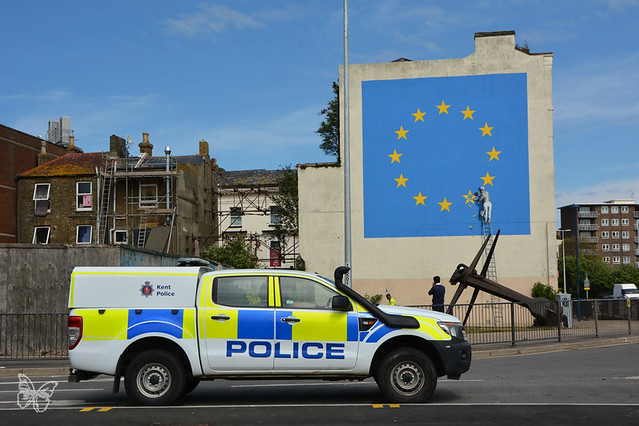
According to reports, Banksy created the work under cover of scaffolding. As the building is earmarked for demolition as part of a waterfront regeneration project, locals thought nothing of it. The three storey mural depicts a workman on a ladder chiselling one of the twelve stars of the European Flag, as a symbolic of the Brexit political process with the UK leaving the EU.

Attention to detail is remarquable, from the shading of the ladder and the stencilled lifesize workman, to the trompe l’oeil effects of the cracks in the European flag achieved by two layers of crisp lines, as well as the chips of the star falling off to the ground .

Banksy in DoverBanksy in DoverBanksy in DoverBanksy in Dover

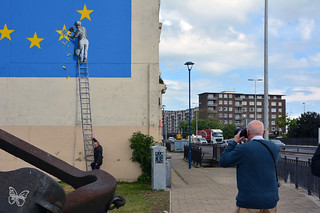
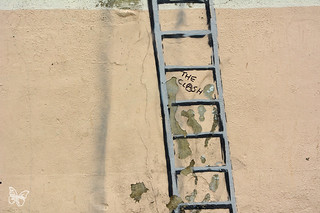
Since appearing on the day of the French presidential elections on 7 May, the mural has generated  a great enthusiasm and pride from local residents and travellers curious to see it in person or photograph it, while a a few opportunists also started to chip some paint pieces from the ladder and scribble ‘The Clash’ on it.

When reality goes beyond fiction: with all the visitors, it appears that the council has instructed city workers to cut the grass around the unauthorised mural for a better photo opportunity ( cover photo), while CCTV and police are doing some random rounds to protect it from vandalism.

Banksy in DoverBanksy in Dover
Banksy in Dover

However there is also another sad twist: the owners of the building, the Godden Family, property developpers in the Kent coast, are planning to sell the mural for £ 1 million (source: Telegraph ) The Godden family said in a statement: “We can confirm that we are exploring options for the retention, removal or sale of the piece.” The family added that it “will look to benefit local charities with proceeds from any sale of the piece”.

Sad times indeed. So get there to see it in person while you can.

Streets in France: Recognize! Vote!

With the historical Presidential election in France divided with candidates including Far Right, we followed anonymous activist artist < + + as he campaigned prolifically as the 12th candidate. His pasters  feature his signature peaceful and poetic futuristic creatures and guardians of an imaginary micronation, also known as totems or TTM on a monochrome blason, playing on the duality of night & day, while the slogans ‘Recognize!’ and ‘Vote!’ raise awareness to take action against intolerance and extremism.

This slideshow requires JavaScript.

Streets: New Banksy in Dover

Banksy Dover.jpg

As the UK heads towards a general election and Britain prepares to leave the EU, a three-storey version of the European Union flag appeared painted on to a residential building, on Saturday morning, near the ferry port off the A20 in the Kent seaside town of Dover. The mural features a monochrome stencilled image of a man chiseling off one of the 12 stars.  The anonymous artist later confirmed his ownership by publishing two photos of the painting on his Instagram feed and website.

Photo: Banksy’s website

Paris: JR – Wrinkles of the City Istanbul

Gallery Perrotin in Paris is currently showing the latest instalment of ‘Winkles of the City – Istanbul’, a project created by French artist JR, featuring monumental portraits across cities dedicated to the elderly people and their stories.

In May 2015, JR created works on 15 buildings all over Istanbul, a city seen as a link between Europe and Asia, and not far from new conflict zones. In the last chapter of his project ‘The Wrinkles of the City’, JR portrays older people who have lived through the changes and upheavals of their city – especially the secularization of Istanbul after 1924 – and enlarges their portraits to reflect the changes in the architecture of various areas of the city.

JR -WRINKLES OF THE CITY ISTANBULJR -WRINKLES OF THE CITY ISTANBULJR -WRINKLES OF THE CITY ISTANBUL

In parallel to the pictures and artworks exhibited, the show features a screening ‘Wrinkles of the City’.

JR- Wrinkles of the City Istanbul
Until 13 May
Galerie Perrotin
76 Rue de Turenne, 75003 Paris