
Understanding the New Cognitive Domain, is the first exhibition of work by Japanese artist Takashi Murakami at the Gagosian Gallery in Le Bourget, main private air hub on the outskirts of Paris, France.
Focused on his monumental paintings. The exhibition features five such works plus others in smaller formats and several sculptures.
Murakami wanted to offer the French public a window on Japanese history, the history of Asia, creating bridges between Western culture and Eastern culture, the digital world and the real world, abstract art and figurative art.
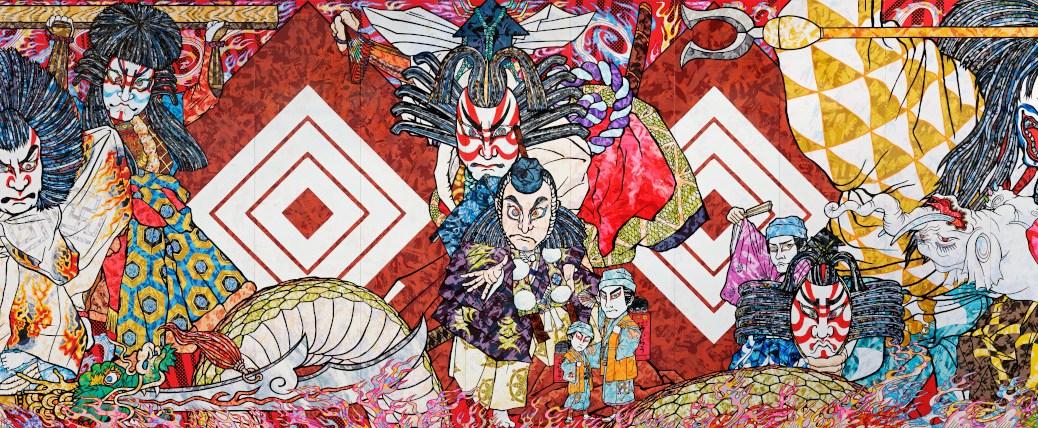
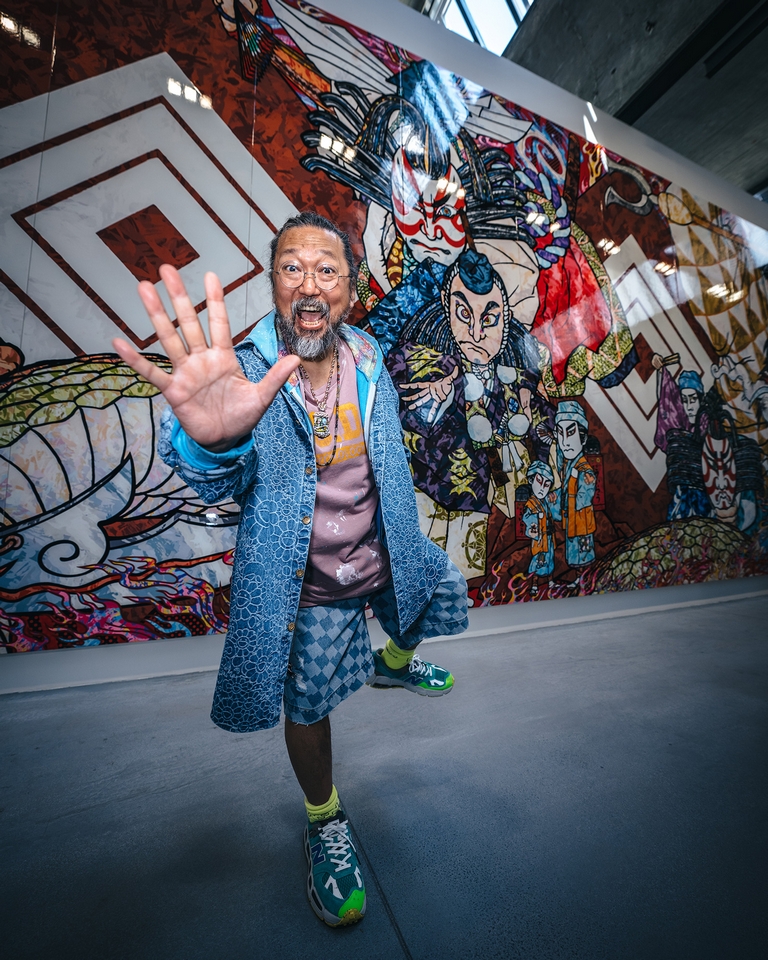
Two monumental frescoes welcome the visitors upon entering the gigantic warehouse gallery space. A new 5 x 23-meter painting by Murakami is based on the iwai-maku, or stage curtain, that he produced for the Kabuki-za theater in Ginza, Tokyo.

The frescoe titled ‘The Name Succession of Ichikawa Danjūrō XIII, Hakuen, Kabuki Jūhachiban (2023)’ pays tribute to traditional Japanese Kabuki theater, and specially the stage name Ichikawa Danjūrō XIII, Hakuen by Japanese Kabuki actor and producer Ichikawa Ebizō XI.
Stage names, which specify an actor’s style and lineage, are passed down through generations and the Ichikawa family has a roughly 350-year history. Murakami’s design, which was commissioned by film director Takashi Miike, was unveiled during the first performance of Ichikawa Shinnosuke VIII at the November Kichirei Kaomise Grand Kabuki Theater program earlier in November 2022.

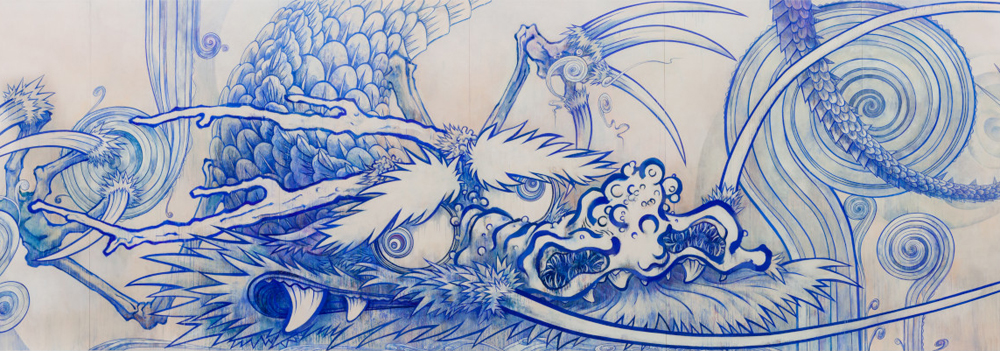
The second monumental painting, Dragon in Clouds – Indigo Blue (2010), is a reference to eccentric Japanese artist Soga Shōhaku’s Dragon and Clouds (1763). Shōhaku’s work is a multi-panel Unryūzu (cloud-and-dragon) painting in which the creature appears as a Buddhist symbol of optimism and good fortune. Murakami’s painting resonates with contemporary Japanese visual culture, particularly the video game Blue Dragon, while its vast scale revives the visceral and psychological impact of Shōhaku’s masterpiece.
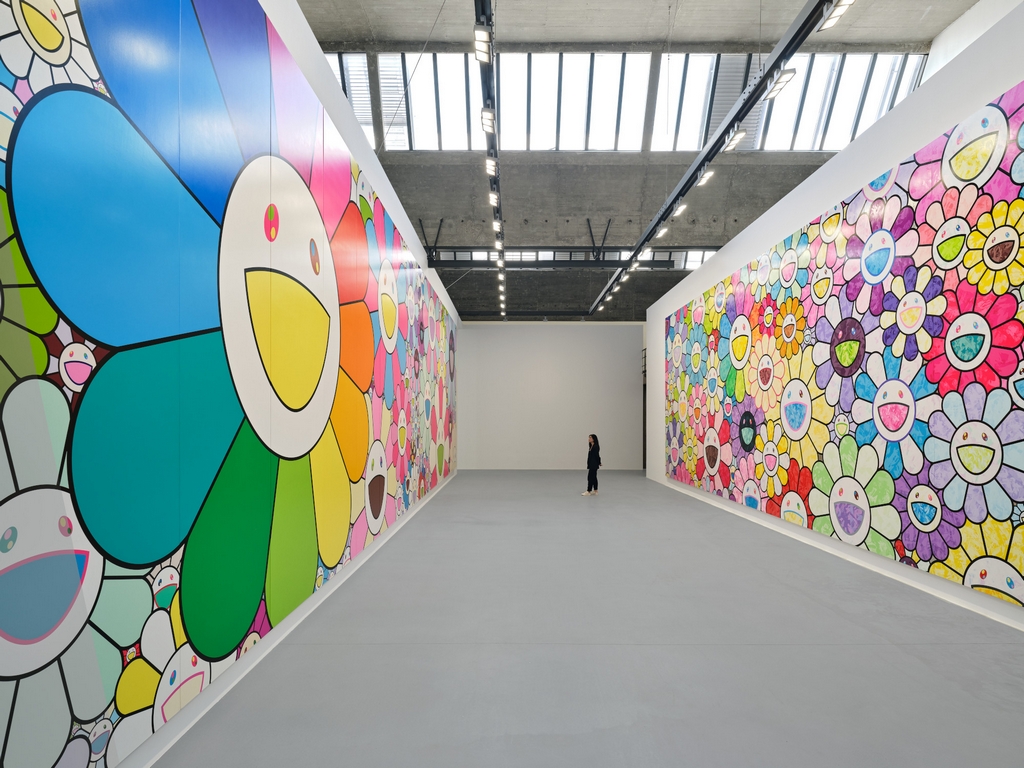
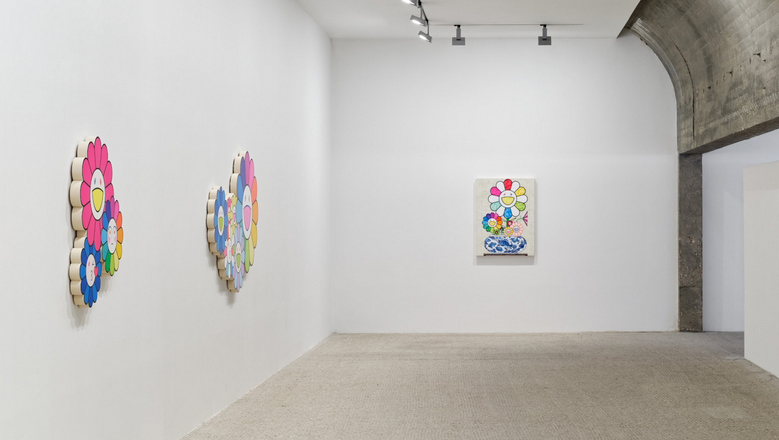
In the second space, two frescoes respond to each other, like a distorting mirror: one is the perfect illustration of the Superflat style (a movement halfway between pop art and Japanese kawaii culture invented by Murakami in the 2000s), and the other features sunflowers in a marbled effect.
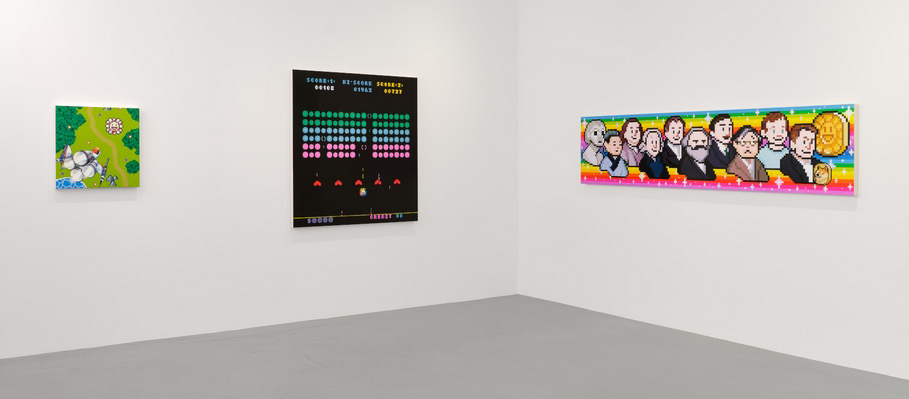
Between traditional art and contemporary art, Murakami’s heart swings. He recently became interested in cryptoart, and he even launched his own NFT project, Murakami Flowers, last year. “During the pandemic, I really felt that the line between the real and digital world was becoming more and more blurred, and I think NFTs are the artistic expression of this permeability. I create NFTs to insert myself into this metaverse and then make real paintings to explain the world of NFTs to people in the real world . ”
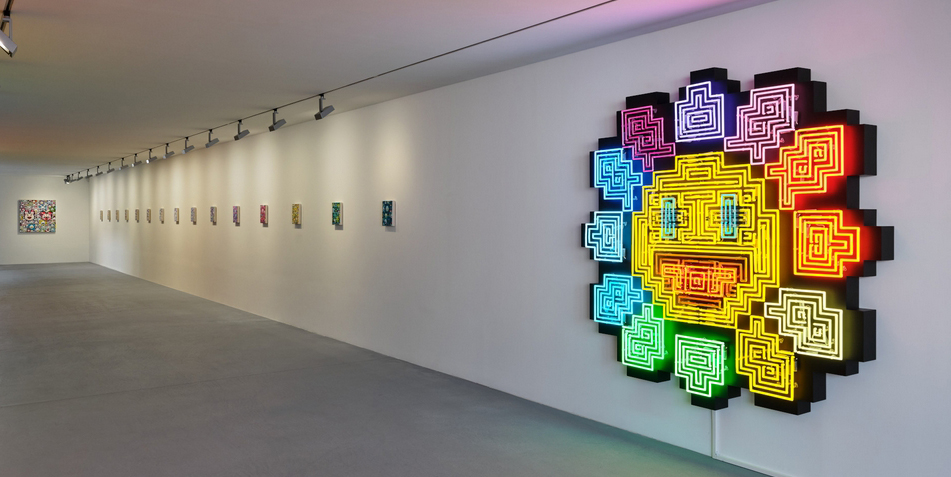
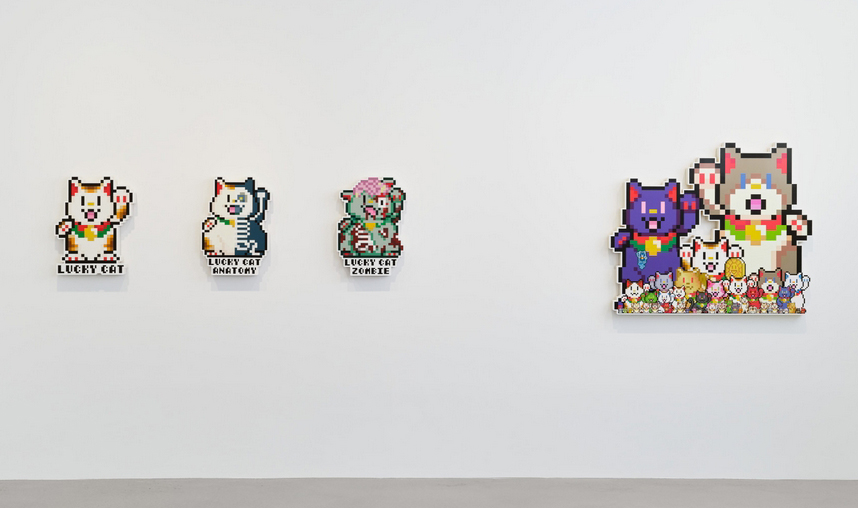
Also on view are several “lucky cat” paintings that reference the artist’s recent NFT projects, and other works featuring Murakami’s iconic smiling flower motif—including a two-meter rainbow neon sign—in which the artist again employs a retro-digital variant on his influential Superflat aesthetic.

Two mirror-plated figures representing futuristic anime-style avatars reinvest the Clone X NFTs (2021) that Murakami developed in collaboration with RTFKT Studios with physical presence, reflecting his fascination with the metaverse and his sensitivity to the hybrid nature of agency in today’s world.
His ever-proliferating cartoonlike blossoms function as immediately recognizable and infinitely flexible icons that may be at once ornamental and symbolic, directing the viewer toward intertwined themes of identity, representation, and technology.
The exhibition shows the full extent of Murakami’s talent and his artistic references, ranging from the masters of the Edo period (1603-1867) to the aesthetics of video games through American abstract artists.
Understanding the New Cognitive Domain is on view through December 22 @ Gagosian Le Bourget
Pictures courtesy the artist and Gagosian
 butterflyartnews.com