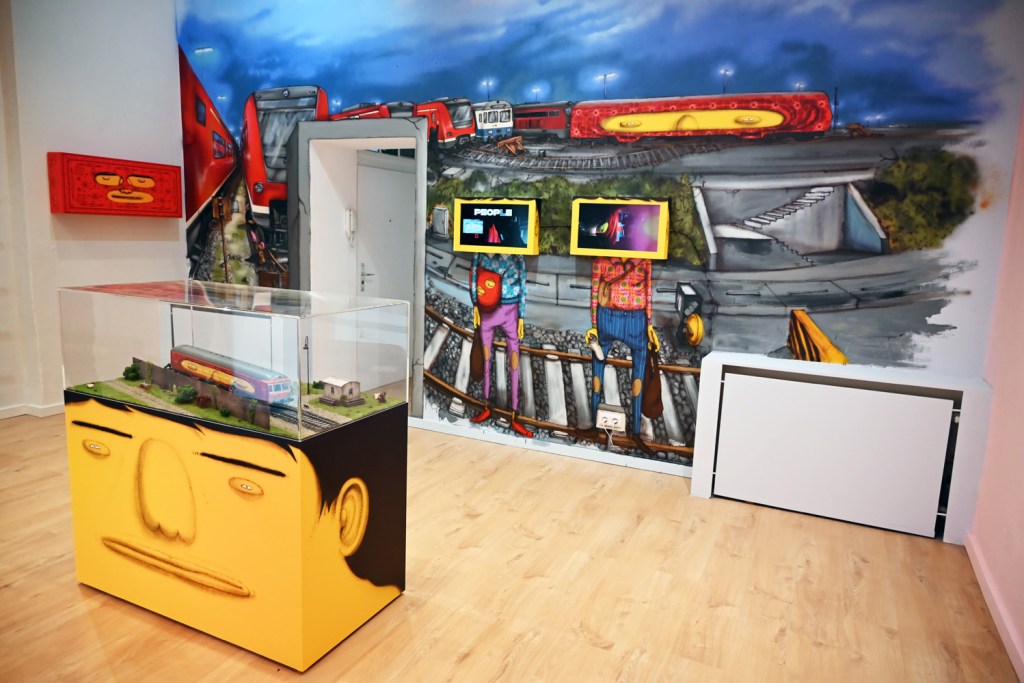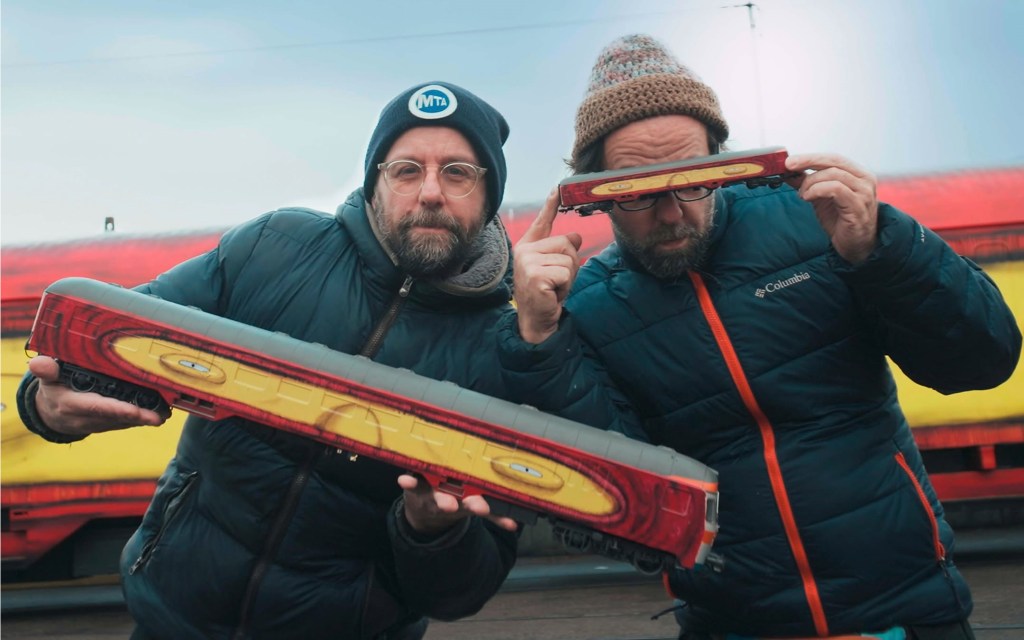
With a continuous fascination of trains since their early beginnings, Brazilian graffiti duo OS GEMEOS is now co-operating with Märklin, a German company founded in 1859 and market leader in the global model railway industry.
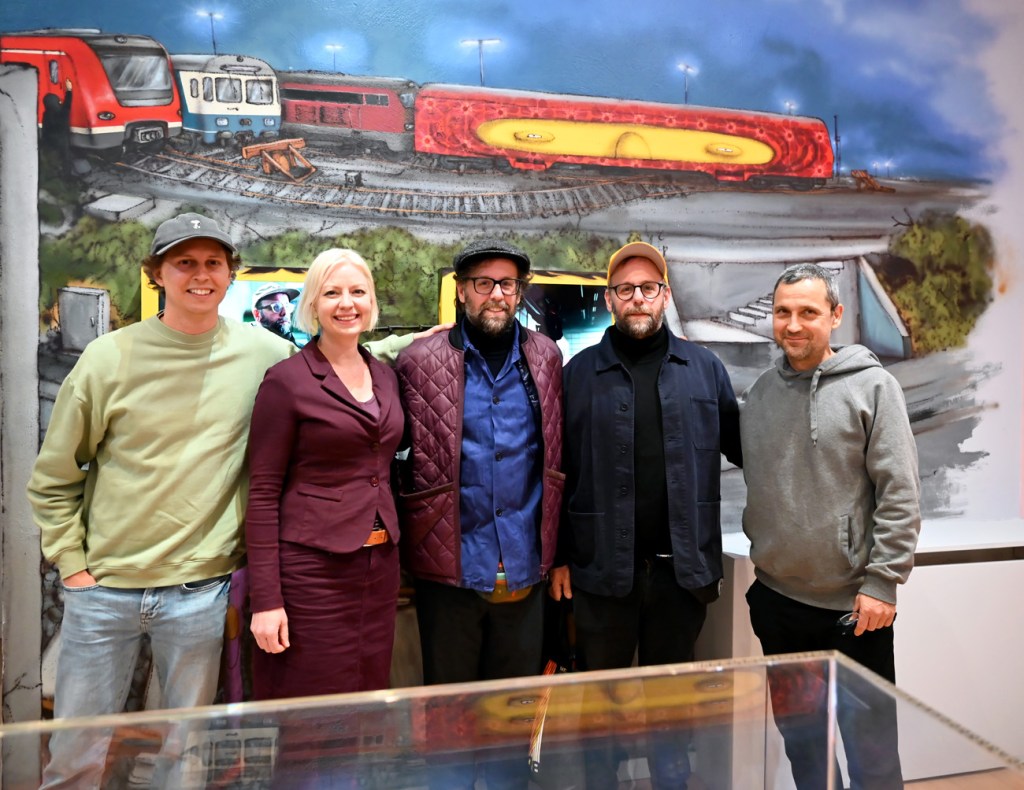
Florian Sieber from Märklin , Düsseldorf Mayor Clara Gerlach, Os Gemeos and Hood Gallery owner Peter Michalski
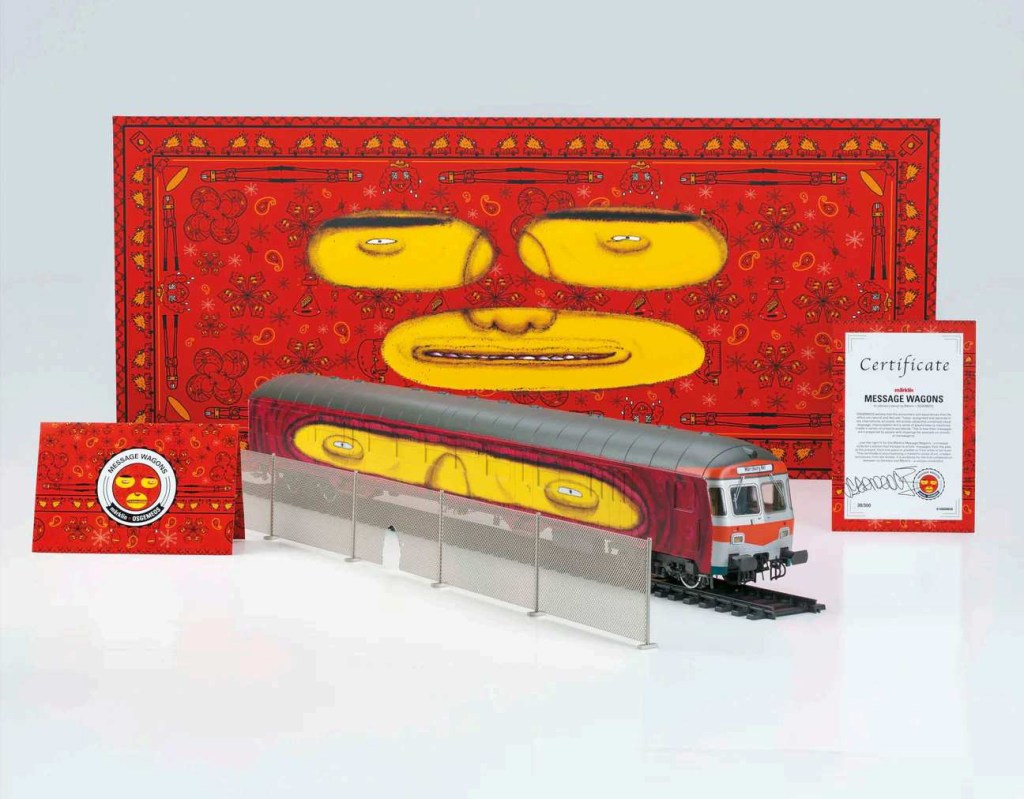
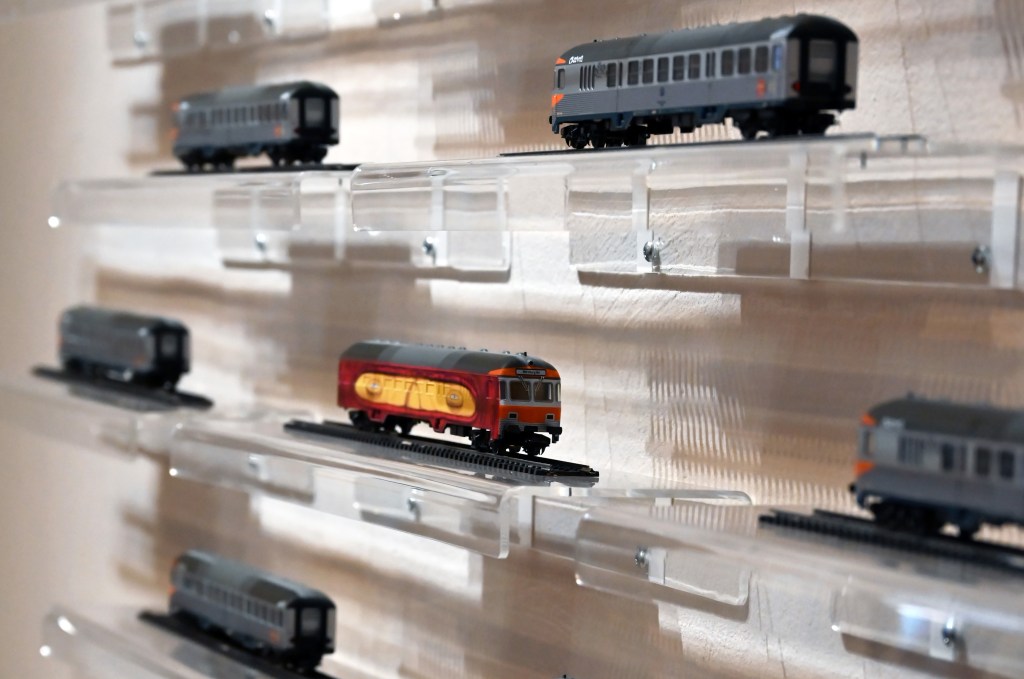
Together they are presenting two new, strictly limited art wagons for collectors and model railway fans. The models can be discovered at www.maerklin-messagewagons.com until 11 April at 23:59 CEST.
Their colourful, cheerful figures are emblazoned on two Märklin Message wagons that combine art and model railway in a unique way.
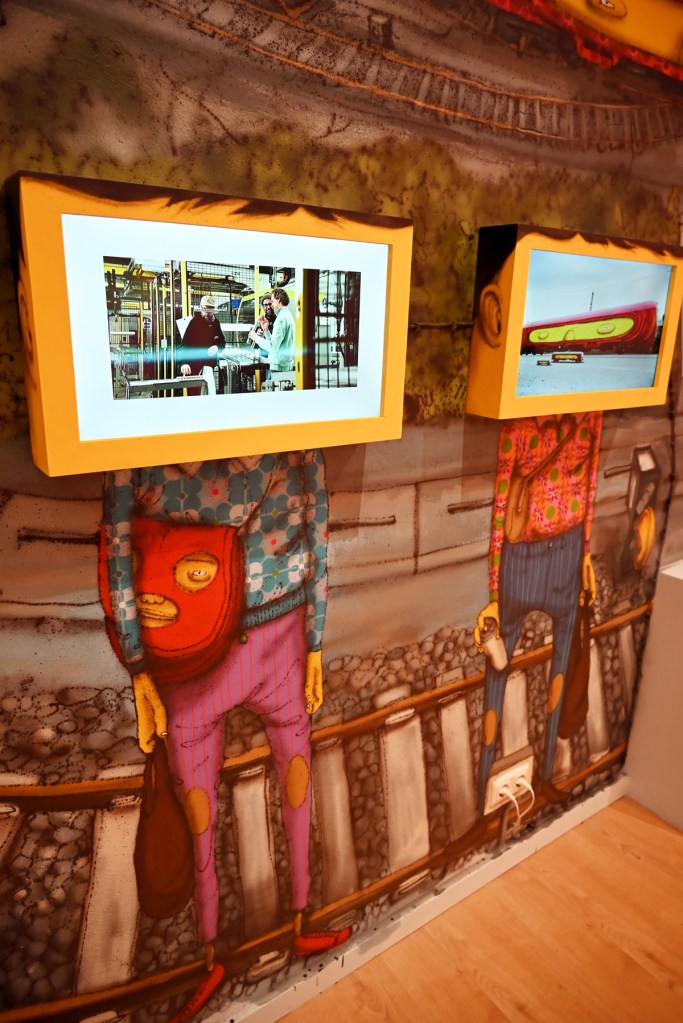
While visiting the Märklin production company in Göppingen, the artists were inspired by the attention to detail with which each model is created. A motif was spontaneously created on site on a wagon in its original size.
Märklin is now releasing this motif as exclusive Märklin Message Wagons in the 1:32 (1:87) and H0 (1:32) model railway scales.
‘We are crazy with the details – anything is possible here,’ the twins put their delight into words during their visit to the Märklin factory.
Check pictures of the opening and the releases in more details
Palazzo Esposizioni Roma presents L’ultimo meraviglioso minuto, an exhibition by contemporary Italian artist Pietro Ruffo, from 29 October until 16 February 2025.
Curated by Sébastien Delot, Director of the collections and mediation of the Musée National Picasso in Paris, the show is the largest solo exhibition by Ruffo ever held by a public institution to date.
Through more than 50 works, mostly created specifically for this exhibition, the artist explores the impact of Man on planet Earth, exploring the legitimacy of the term Anthropocene, the alleged geological era of man, and condensing the history of our planet and knowledge, and pays a great tribute to the City of Rome.
The exhibition plays on the dilation and contraction of time and space, the history of the planet and humanity—within the singular space and time of the encounter with the artworks.
The exhibition begins 55 million years ago. The title of the first room, Le monde avant la création de l’homme (The World Before the Creation of Man), is borrowed from the book by Camille Flammarion, subtitled “origines de la terre, origines de la vie, origines de l’humanité” ,1886.)
Ruffo outlines the characteristic elements of this planet. Using a ballpoint pen, he draws a primordial forest, creating an immense curtain (700 square metres) running along the entire perimeter of the space (Primordial Forest), surrounding visitors with images of plants and minerals, that evokes the time when tropical jungles covered much of the Earth’s surface.
The room is intersected by a large self-supporting structure (4 metres by 21), on which he depicts a section of the Grand Canyon, painted in ink on canvased paper using the camaïeu technique (utilising different tones of the same colour, in this case, burnt sienna). Beyond this grand structure, the public finds themselves walking among traces of the Earth’s past life: 21 circular works of varying sizes, titled De Hortus, floating like water lilies on the white floor, creating a chromatic atmosphere of great visual impact.
The exhibition journey then moves into the Anthropocene, the geological era in which the Earth’s environment—understood as the sum of the physical, chemical, and biological characteristics that support and evolve life—has been influenced by the effects of human activity.
“If we boil down the Universe’s 13.8 billion years to a period of twelve months, the dinosaurs would appear around Christmas time – unbelievable! – while the first Homo Sapiens would only arrive on the scene a few minutes before the New Year’s fireworks.”
It is to these fleeting last minutes of our planet’s history that the subsequent three rooms are dedicated, where Pietro Ruffo explores human intervention in search of ‘marvel’.
In the second room, which showcases works on canvased paper, with cuts and ink drawings, visitors are immersed in a visual archive symbolically retracing the steps of our ancestors’ evolution, from the Neanderthal skulls of Saccopastore to votive figurines, the first emblem of abstract thought upon which societies are built.
In the third room, with a radical change of scenery, visitors are enveloped in a video installation titled The Planetary Garden, created in collaboration with Noruwei. Inspired by the eponymous text by French philosopher Gilles Clément, the work gives three-dimensional form to the movement, shift, and transformation of the landscape over time.
The final room, titled Antropocene attraverso le stratificazioni di Roma(The Anthropocene Through the Stratifications of Rome), features works entirely dedicated to the city. What was Rome like 2,777 years ago, at the time of its founding? And even earlier, when the streets we walk today were trodden by jaguars and rhinoceroses? Starting with the famous maps of the city by Giovanni Battista Nolli (1701-1756) and Luigi Canina (1775-1856), Ruffo overlays these with unexpected glimpses of natural landscapes, offering a novel walk through the history and prehistory of the Roman territory. The works in this room allow visitors to move from the depths of the sea (Anthropocene 77, Rome Under the Sea), to the primordial forest (Anthropocene 92, Rome Covered by a Primordial Forest), and then to the theatre of great architectural constructions (Anthropocene 51, Rome Imperial Period; Anthropocene 53, Rome Porta Maggiore, and others). The anthology of landscapes explored in these works presents a mosaic of historical and hypothetical future moments, in which each transformation is simultaneously the consequence of natural events and human intervention. Cuts in canvased paper, pen drawings, oil paintings, and reliefs come together in a compositional harmony that invites deep observation.
The palaeoclimatologist Rebecca Wragg Sykes, in her renowned work Neanderthals: Life, Art, Love and Death, referring to Carl Sagan’s ‘cosmic calendar’, writes:
The exhibition also features a catalogue curated by Sébastien Delot, with contributions from the curator, Guido Rebecchini, Rebecca Wragg Sykes, and Sofia Di Gravio, published by Drago.
Through marvel, Pietro Ruffo’s works offer a unique visual and immersive experience, shedding new light on the environmental issues that permeate our everyday existence in society.
Since the 5 August 2024, elusive artist Banksy has been treating London with some new stencil artworks accross the city.
On 5 August, off Kew Bridge in Richmond, a silhouette of a goat appeared on top of a ledge looking down cheekily at CCTV camera, with debris falling down the side of the building.
On 6 August a couple of elephants in separate rooms are facing each other in the district of Chelsea.
On 7 August, three monkeys are playfully balancing underneath the London overground bridge off Brick Lane in East London.
Update – 08 August 2024
On day 4 of his animal themed serie, Banksy unveiled a wolf howling on full moon, making a clever use of a satellite dish.
Image PA
Located in Peckham Rye, South London, the sattelite dish with the artwork got stolen less than one hour after being confirmed by the artist.
Update 09/08
On this fifth day, Banksy unveiled an artwork of pelicans pinching fish from a London chip shop sign. Located on Bonners Fish Bar in Walthamstow, the artwork shows one bird stooping down to scoop up a fish on the takeaway’s sign, while another is tossing one in the air.
10/08/2024
Banksy has confirmed the sixth artwork in his new animal-themed collection across London, a silhouette of a panther on an empty, distressed billboard. The mural is located in Edgware Road, Cricklewood
11/08/2024
This time it’s in Ludgate, with another more elaborate style. It depicts piranhas swimming in a police entry box.
Image Banksy
12/08/2024
Banksy is still on a roll, with a humorous stencil of a rhino strategically placed, looking as if it’s mounting a car with a traffic cone on its hood. It’s all about placement…
Located in Westmoors St, Charlton.
Image Banksy
13/08/2024
A ninth piece appeared on a white shutter at the London Zoo, with a gorilla depicted lifting its base the release birds and a seal, with more eyes glowing the darkness.
Elusive artist Banksy unveiled a new mural in Finsbury Park, North London on Saint Patrick’s day. Located in Hornsey Road, a social housing area, the council recently pruned a massive mature cherry tree, as part of their regular maintenance, and left it looking miserable.
Before Banksy mural – image courtesy of the artist
Using a pressure hose or fire extinguisher, Banksy painted a cascade of green colour on the façade of the nearby building, creating a trompe l’oeil effect. At the bottom the mural Banksy used a stencil to paint a lifesized person holding a pressure hose next to it. When stepping back, it looks like the tree is bursting to life.
Banksy’s attention to detail is noticeable with the green colour palette matching the one used by Islington Council for signs in the local area. This also helped him act unnoticed despite the bright green colour.
This fire extinguisher technique is a favourite amongst graffiti artists as it enables to cover large surfaces high and wide quickly without the need of a ladder or scaffholding.
Local residents expressed joy and pride to the addition of this major cultural element to their streets.
Listen to the podcast on BBC with James Peak and Patrick Nguyen here
Placement and timing are key. A celebration of the green colour (perfect timing with Saint Patrick’s day), combined with a celebration of nature and the springtime season in full bloom.
Update 20.03.2024
Street art is ephemeral by nature.
The mural did not last long in its original state. Three days after unveiling the piece, the wall has received some white splash paint, as well as a little addition with a brick signature character by Ronzo. Can you spot it?