All posts by butterfly

INVADER SPACE STATION in Paris

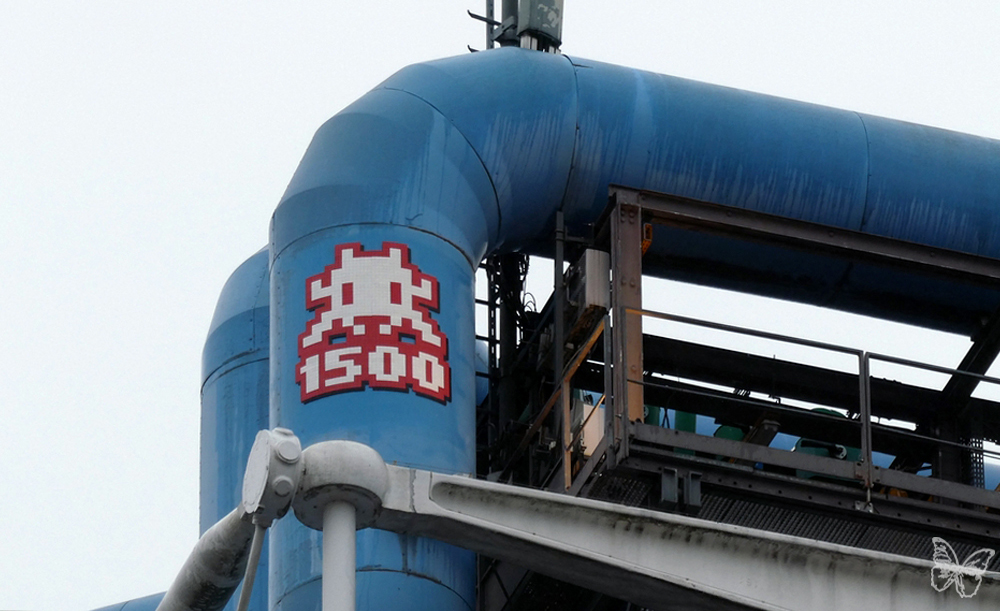
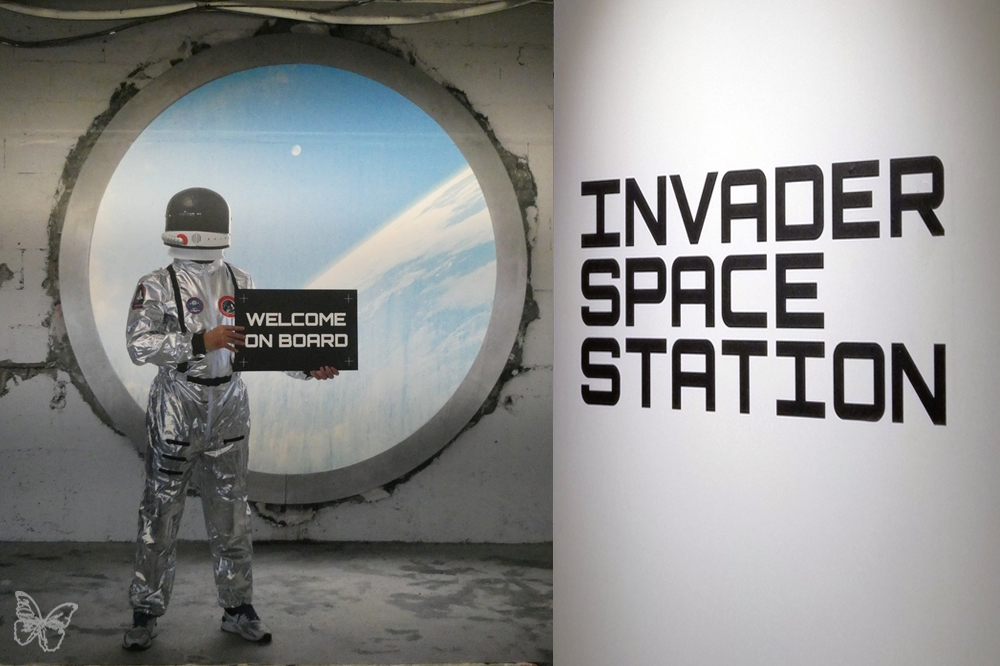
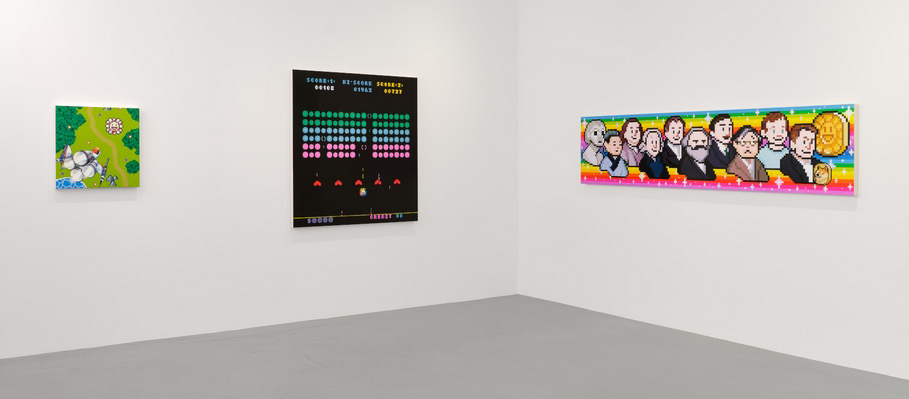
Celebrating his 1500th piece in Paris at the top of Contemporary Art Museum Centre Pompidou, the French artist Invader is taking over an entire building in central Paris and transforming it into a space station: the INVADER SPACE STATION.

Located 11 rue Béranger (75003) in the former offices of the newspaper ‘Libération’ ( which were invaded by the artist back in 2011), the exhibition is curated by Fabrice Bousteau, editorial director of Beaux Arts Magazine.

This massive exhibition of 3500 m² accross nine floors will feature pictures, videos, sculptures and installations. So get ready to be invaded.

INVADER SPACE STATION

From 17 February to 5 May 2024

Prebooked tickets can be purchased on invaderspacestation.seetickets.com/timeslot/invader-space-station

CUTE Exhibition at Somerset House

A major new exhibition exploring the irresistible force of cuteness in contemporary culture will be opening at the Somerset House in London from 25 January to 14 April 2024 .

Starting of with the celebration of the cat, to the influence of the japanese culture of cuteness ‘Kawaii’, CUTE brings together contemporary artworks, including new artist commissions, and cultural phenomena such as music, fashion, toys, video games and social media.

From emojis to internet memes, video games to plushie toys, food to loveable robotic design, cuteness has taken over our world. But how has something so charming and seemingly harmless – adorable, doe-eyed animals, chubby-cheeked babies, flowers, hearts, stars, sweets and other such romantic motifs – gained such traction?  

Examining the world’s embrace of cute culture and how it has become such an influential measure of our times, the exhibition will seek to unravel cuteness’ emotive charge, revealing its extraordinary and complex power and potential.   

Contributing artists include Mark Leckey, Sean-Kierre Lyons, Aya Takano, Mike Kelley, Karen Kilimnik, Nayland Blake, Cosima von Bonin, Hannah Diamond, Ed Fornieles, Juliana Huxtable, Rachel Maclean, Julien Ceccaldi, Paige K. B., Isaac Lythgoe, Alake Shilling, Wong Ping, Liv Preston, CFGNY, Ram Han, Maggie Lee, Bunny Rogers, Flannery Silva, Andy Holden, plus Somerset House Studios artists Chris Zhongtian YuanSin Wai Kin and Sian Fan.  

The exhibition will also feature a games arcade for all ages and will spotlight and celebrate the 50th anniversary of one of cute’s most iconic and ubiquitous figures, Hello Kitty, in partnership with Sanrio.

IP infringement: leaked list containing over 16,000 non-consenting artists allegedly used to train Midjourney’s AI

We kick start 2024 with a growing issue related to AI, as to the ongoing debate on copyright and consent in AI image creation.

Lists containing the names of more than 16,000 artists allegedly used to train the Midjourney generative artificial intelligence (AI) programme have gone viral online.

The lists were both partially included in a recent class-action lawsuit and accidentally shared via a public Google spreadsheet named “Midjourney Style List”. While initially restricted, the list supposedly retrieved from Midjourney developers during a process of refining the programme’s ability to mimic works of specific artists and styles, is still partially visible on the Internet Archive ( by clicking on the Proposed Additions as well as Artists sections).

The partial list features over 4000 artist names from a variety of art periods, contemporary art like Keith Haring Haring, Damien Hirst, Yayoi Kusama, Barbara Kruger, Guerilla Girls as well as graffiti and street artists.

Some of the street artists include: Banksy, Invader, Shepard Fairey , Adam Neate, Cornbread, Jef Aerosol, Faith47, Olek, Os Gemeos, Paul Insect, Miss Tic, Miss Van, JR, Retna, Swoon, Stik, Vhils, Zevs to name a few.

Many of the artists and prompts also feature in publicly accessible court documents for a 2023 class-action lawsuit, within a 25-page list of names referenced in training images for the Midjourney programme.

Even though the practice of using human artists’ work without their permission to train generative AI programmes remains in uncertain legal territory, controversies surrounding documents like the “Midjourney Style List” shed light on the actual processes of converting copyrighted artwork into AI reference material.

Further details on the subject on The Art Newspaper

Takashi Murakami – Understanding the New Cognitive Domain at Gagosian Le Bourget

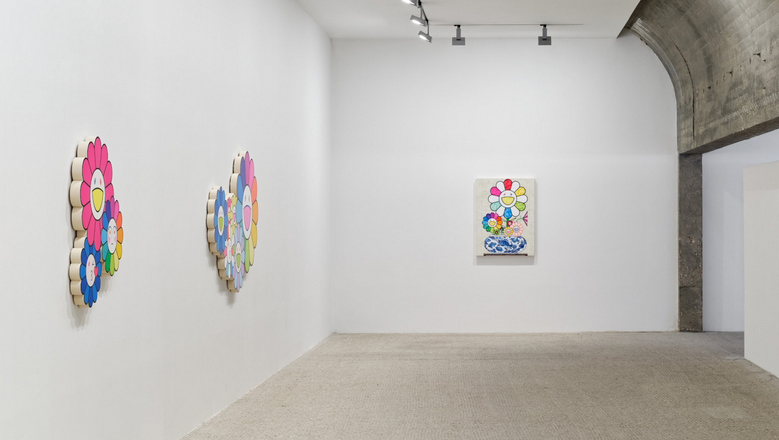
Understanding the New Cognitive Domain, is the first exhibition of work by Japanese artist Takashi Murakami at the Gagosian Gallery in Le Bourget, main private air hub on the outskirts of Paris, France.

Focused on his monumental paintings. The exhibition features five such works plus others in smaller formats and several sculptures.

Murakami wanted to offer the French public a window on Japanese history, the history of Asia, creating bridges between Western culture and Eastern culture, the digital world and the real world, abstract art and figurative art.

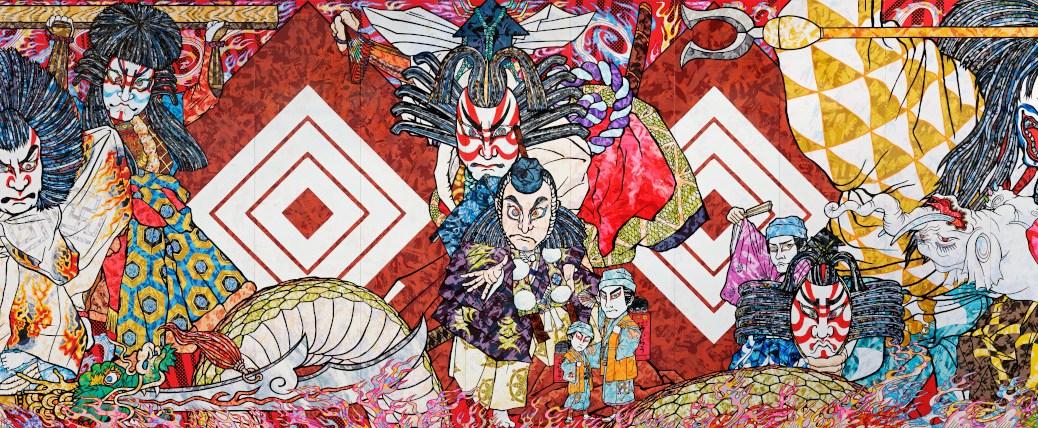
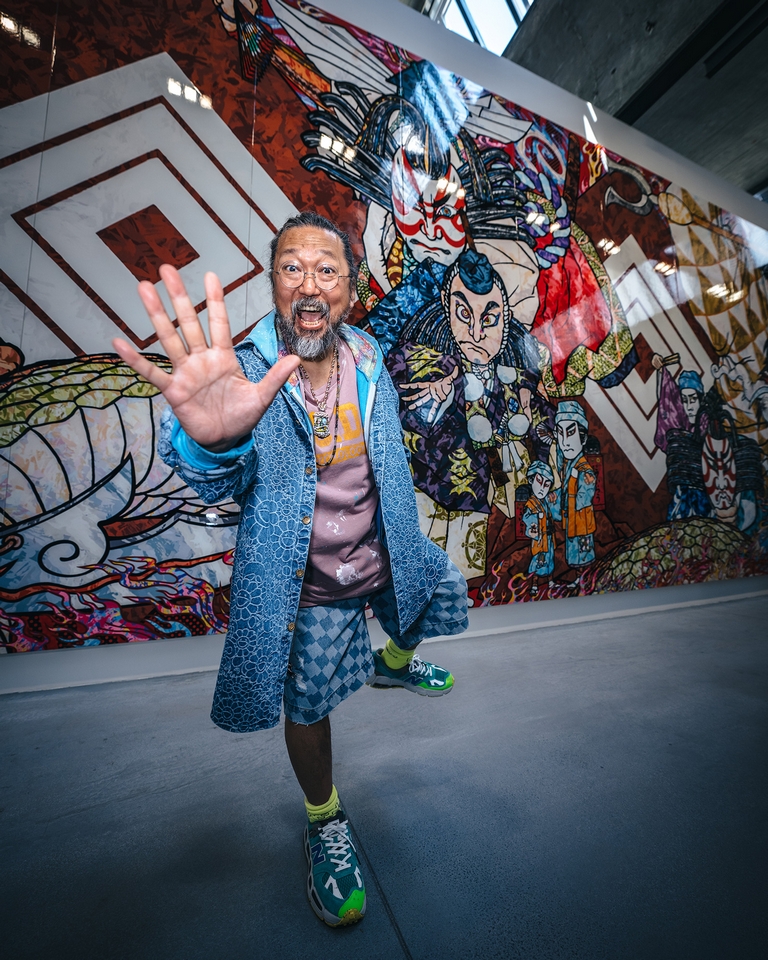
Two monumental frescoes welcome the visitors upon entering the gigantic warehouse gallery space. A new 5 x 23-meter painting by Murakami is based on the iwai-maku, or stage curtain, that he produced for the Kabuki-za theater in Ginza, Tokyo.

The frescoe titled  ‘The Name Succession of Ichikawa Danjūrō XIII, Hakuen, Kabuki Jūhachiban (2023) pays tribute to traditional Japanese Kabuki theater, and specially the stage name Ichikawa Danjūrō XIII, Hakuen  by Japanese Kabuki actor and producer Ichikawa Ebizō XI. 

Stage names, which specify an actor’s style and lineage, are passed down through generations and the Ichikawa family has a roughly 350-year history.  Murakami’s design, which was commissioned by film director Takashi Miike,  was unveiled during the first performance of Ichikawa Shinnosuke VIII at the November Kichirei Kaomise Grand Kabuki Theater program earlier in November 2022.

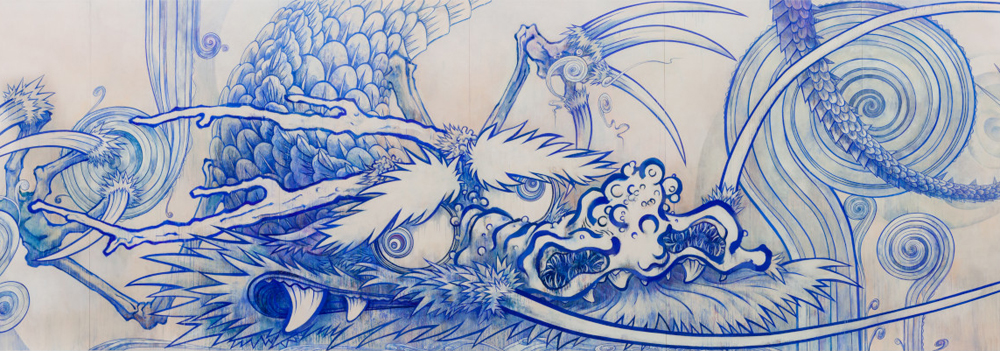
The second monumental painting, Dragon in Clouds – Indigo Blue (2010), is a reference to eccentric Japanese artist Soga Shōhaku’s Dragon and Clouds (1763). Shōhaku’s work is a multi-panel Unryūzu (cloud-and-dragon) painting in which the creature appears as a Buddhist symbol of optimism and good fortune. Murakami’s painting resonates with contemporary Japanese visual culture, particularly the video game Blue Dragon, while its vast scale revives the visceral and psychological impact of Shōhaku’s masterpiece.

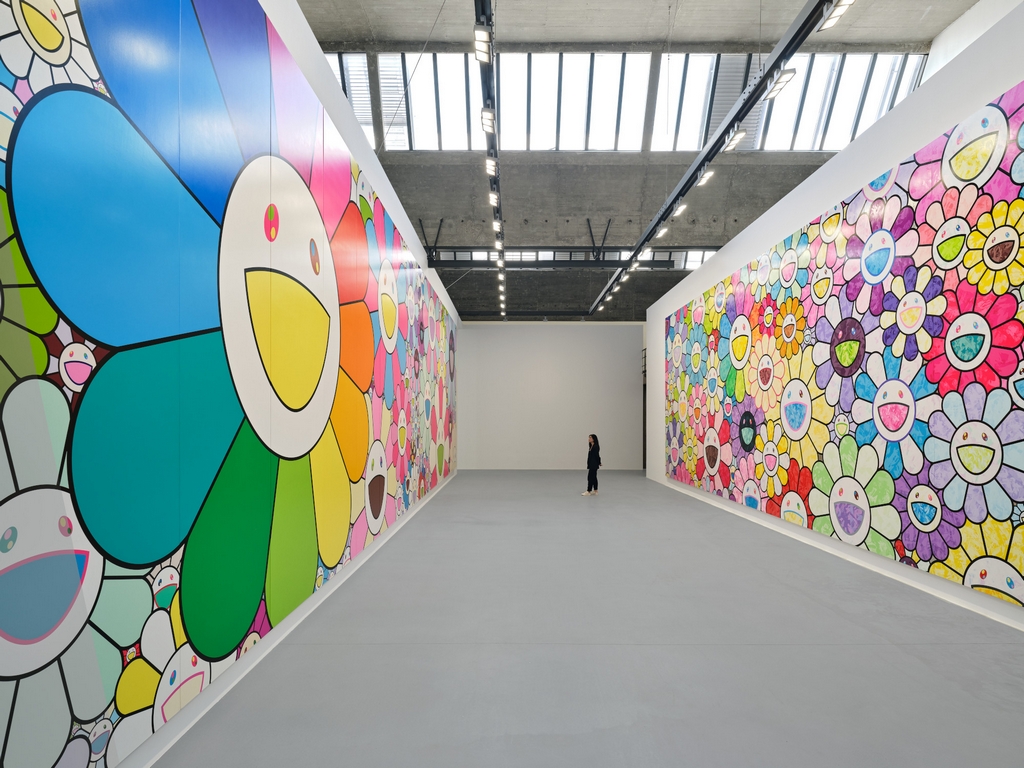
In the second space, two frescoes respond to each other, like a distorting mirror: one is the perfect illustration of the Superflat style (a movement halfway between pop art and Japanese kawaii culture invented by Murakami in the 2000s), and the other features sunflowers in a marbled effect.

Between traditional art and contemporary art, Murakami’s heart swings. He recently became interested in cryptoart, and he even launched his own NFT project, Murakami Flowers, last year. “During the pandemic, I really felt that the line between the real and digital world was becoming more and more blurred, and I think NFTs are the artistic expression of this permeability. I create NFTs to insert myself into this metaverse and then make real paintings to explain the world of NFTs to people in the real world . ”

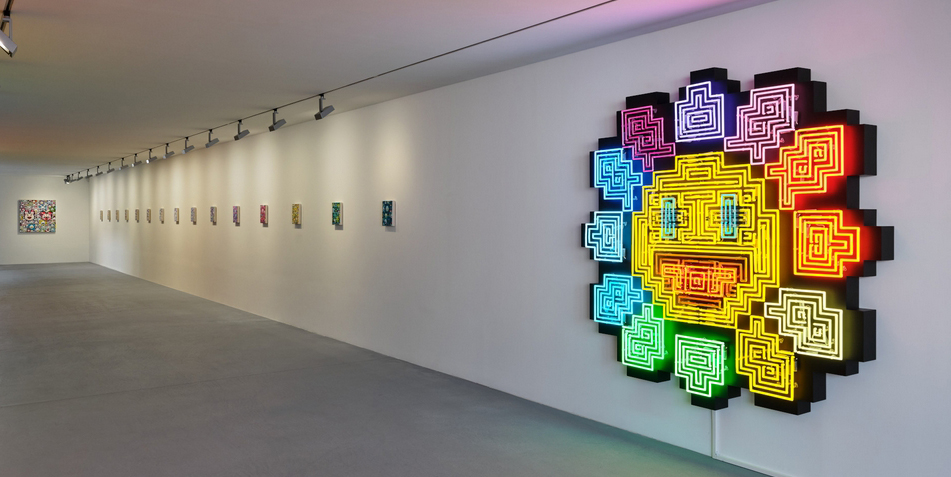
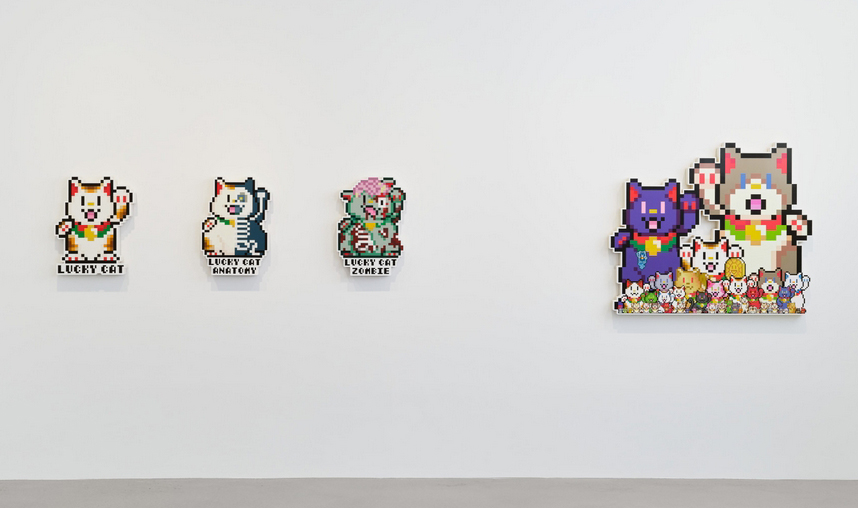
Also on view are several “lucky cat” paintings that reference the artist’s recent NFT projects, and other works featuring Murakami’s iconic smiling flower motif—including a two-meter rainbow neon sign—in which the artist again employs a retro-digital variant on his influential Superflat aesthetic.

Two mirror-plated figures representing futuristic anime-style avatars reinvest the Clone X NFTs (2021) that Murakami developed in collaboration with RTFKT Studios with physical presence, reflecting his fascination with the metaverse and his sensitivity to the hybrid nature of agency in today’s world.

His ever-proliferating cartoonlike blossoms function as immediately recognizable and infinitely flexible icons that may be at once ornamental and symbolic, directing the viewer toward intertwined themes of identity, representation, and technology.

The exhibition shows the full extent of Murakami’s talent and his artistic references, ranging from the masters of the Edo period (1603-1867) to the aesthetics of video games through American abstract artists. 

Understanding the New Cognitive Domain is on view through December 22 @ Gagosian Le Bourget

Pictures courtesy the artist and Gagosian

Limited Edition Art Wrapping Paper for the Big Issue

Get the Holiday season wrapped up in style and create a social-echo at the same time by snapping up some exclusive wrapping paper, designed by a collection of the  country’s best contemporary artists !

Since 1991 the Big Issue is helping homeless and disadvantaged people earn an income and reintegrate into mainstream society.

Internationally acclaimed artists have partnered with the street newspaper to create exclusive, highly collectableone-of-a-kind limited edition designs: Stanley Donwood, Aida Wilde, David Speed, Victoria Topping, Patrick Hugues, Alma Singer, Augustine and Bridgeland, Andrew Millar.

Signed and unsigned versions of the designs are available.

All the profit from these wrapping papers goes directly back to The Big Issue to give people living on the margins a hand up.

Order yours online here

.