Interview: Dourone

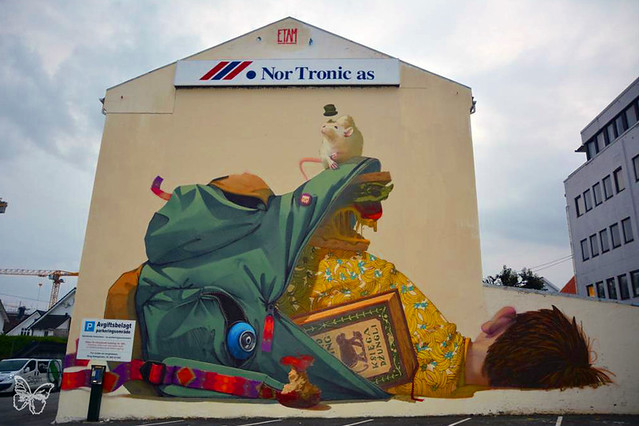
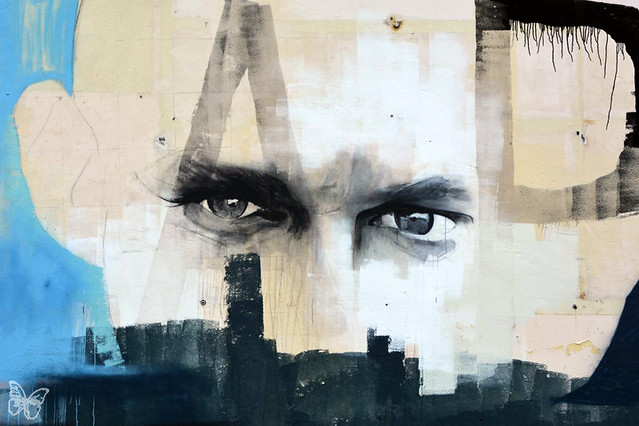
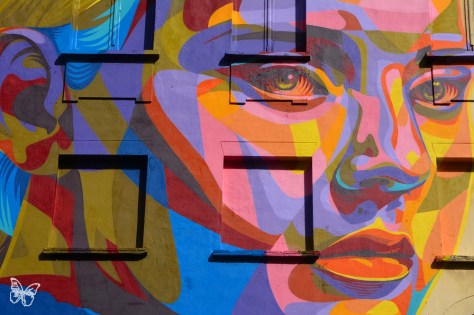
We caught up with Spanish artist Fabio Lopez Gonzalo aka DOURONE as he participates in the 2018 Crystal Ship Festival to learn more about his creative process, his duo with Elodiellol their upcoming projects.

B: Can you tell us more about your background?

D: (Fabio)My background is a boy who lived far away from the center of Madrid and very far from his friends and for that reason he was a long time just drawing. When I was little I used to go to my grandmother’s house, I used to go shopping in the market and I always said “Granny, can we go down the drawing aisle?” That hall was a graffiti spot.

When I understood what that hallway was, I started to paint graffiti and since we did not have a group of graffiti friends we created the STA crew, that’s where all of 1999 started.

After my tour has been very varied, in my family there is a lot of creativity so I was never afraid to try different techniques, tools, etc. all my journey has been an apprenticeship and a self-taught evolution, since unfortunately I was not a very good student and I did not study Fine Arts or anything like that, it was also a very hard and very rewarding journey.

I always knew that I wanted to dedicate myself to something creative.
B: How was the situation towards street art/graffiti / legal and illegal graffiti when you grew up in Madrid?

D: When I started, I did not know very well what graffiti was, I did not listen the street art concept until much later.
My first graffiti was a tag but of 6 meters and the next day I bought a magazine from the store (authentic stiletto) and saw what the 3d was, the power line, a throw-up, a pomp, a wild style, a pastel model … and I also understood the rules of the game, in my time it was like this: a silver or throw-up can step on with a piece, and a piece can be stepped on with a mural, that on the one hand.
On the other side was the seniority and the quality of the work and on the other the level of vandalism of each crew.
When they stepped on you, there were the “fines” that consisted of staying at a place and time you had agreed on before, so that you could return the money or the spays that you had spent on the piece and if you did not pay the fine, you would hit with him, to gain respect based on fear.

Madrid in my time was a pretty tough spot, there were many crews and a lot of urban culture. I also think that there was a lot of respect for the older ones. Legal and illegal, the rule was that graffiti is not for sale.

B: Dourone is now an artistic duo, so tell me more about how it started and what is your creative process?

D: This is a nice story since the duo is created from a couple relationship ..
Dourone exists since 1999, when it started in graffiti, and in 2012, Elodiellol and I started our relationship and our professional history together.
We can say that when Dourone really becomes something more serious and professional.
Elodie is the part totally complementary to mine and that’s why I do not call it a duo, I call it 1 + 1 = 3, which means that between the two of us we reach create a third identity without nullifying us as unique.

We have both been learning together and putting everything in its place.

The creative process is the strangest part, I have to create it and put it on a support but I know that this creative process would not be the same if Elodie was not with me in all the conversations and exchanges of support and support in everything that I believe .
When we paint large murals we make them between the two and we get a coordination that works fluid and without errors, based on a lot of time working together.

B: What influenced you to start painting murals?

D: Since I was little I was very interested, so it was a natural process that took me to paint a mural.

In my time the graffiti artists were in the social group where I fit best because I love painting. Painting in public places was normal because graffiti is about that … and painting bigger also for me was a natural process: first you paint in a notebook later on a wall, then a facade of a building and then a tower …
It’s like first a silver, then a piece and finally a mural, for me it was about improving and learning.
When you paint large murals the creative process is much longer and you have a much more intense experience with your mural, and I am still surprised to see a large mural finished, it also has to be said that it is much more sacrificed, tired and sometimes the experience is made too long and it seems that it never ends.

B: What do you like/enjoy about painting in public spaces?

D: At first I liked the adrenaline of painting illegally and that they knew me more in the world of graffiti, then I liked the fact of painting on a wall.
I painted on quiet walls where I could spend many hours painting with my friends a well-worked mural, finally stop making letters to make more illustrations and I realized what it was to paint in a public place with a language that almost everyone understood or it came to influence people in some way.

Based on years of painting I have been accumulating many good experiences and that has been the engine to continue painting. Now it has become part of my life and my work, thanks to that I have been able to travel and meet a lot of people.


B: Your artworks featuring female portraits convey specific messages and values like Respect, Freedom, Trust, Can you tell us more?

D: As you say my female portraits spoke about respect, diversity and freedom. Those three values are very important to me in my life, but as I said, it goes by stages. Now I keep these three values and still learning from them but my work is being simplified and being more complex.
My new work deals with the beauty, composition, color and emotion that it transmits. Now I am very interested in emotions that are difficult to describe, it is a huge world since in each country and each customs has different words that define that emotion (rare)

B: Can you share anecdotal experience from painting a mural in another country? Have you seen any cultural differences through your travels?

D: I have many good and bad experiences but I can tell you two that are excellent.

The first one is from a mural we painted in Paris, and in the weeks they stepped on it with a tag. The tag had disappeared the next week. The next week they step on it with more tags and disappear again: someone was restoring the mural ..
All this story we were seeing through Instragram and we did not understand very well what was happening, so we went to the mural to see it and we realized that it was restored but not by a person who knew how to paint since it was very badly done but the final result was not bad.
The following year we returned to paint the same wall as every year, then a man of about 80 years old appears and tells us that he was expecting us that he liked what we painted a lot. Then he confessed that he liked a lot the previous mural and that he had been taking care of it and restoring it. At that moment we were amazed to know who was the person who had been fixing it because we would never have thought that this man would worry so much for a mural on the street.

And the other story was in France to but in Boulogne-Sur-Mer for their first street art edition festival.
We were painting on a 3 storey building and noticed that an old woman was looking at us from the windows of her house. The next day she came to visit us and bring us some sodas and biscuits without any word. She kept doing that every day until the very last day.
When she saw that we were about to finish it, she came to us and told us that she was living in this house, right in front of the mural we were painting since she was a little girl.
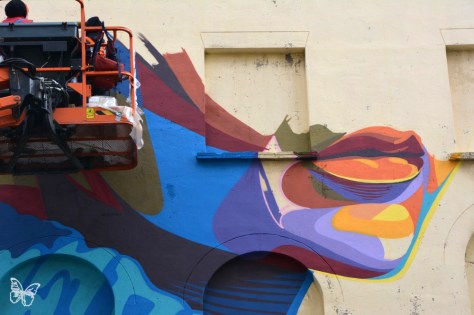
She took our hands and with tears on her eyes she told us:” You know that in this exact place you have your boom lift as you can see, there is a hole between the two buildings. You know why? In 1942, the Germans exploded a bomb right here. I witnessed everything… And now everyday, every time I will look through my window I will see your wonderful and colourful mural. Thank you so much for your present, you cannot imagine what it means to me..” We tried not to cry with her..

And yes of course, there are a lot of cultural differences from one country to another and that is what enrich our experience.

B: What are you creating for the Crystal Ship? Tell us more?

D: What I am creating for the Crystal Ship in an artwork that is based on one of those emotions difficult to describe. OPIA, ambiguous intensity of looking someone in the eye.


B: What are your next projects as well?

D: For this year there are already several closed projects such as the art fair participation in Paris (Urban art fair) a mural in Vannes in France (commission work).
And this year we are invited to participate to the Kaboo Festival in San Diego USA.
Now we are working hard to give us time to do all the projects we want to carry out this year.

More info on DOURONE

London: Print is Power with Sisters in Print

Print is power - Sisters in Print

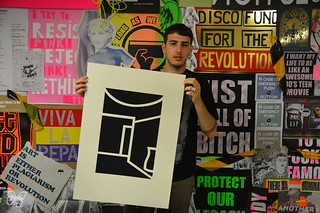
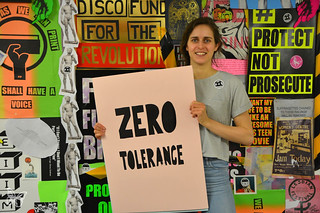
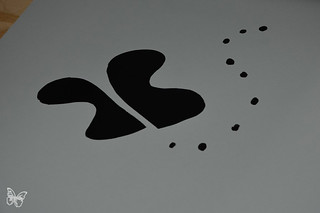
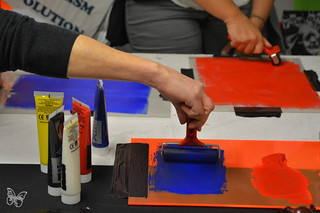
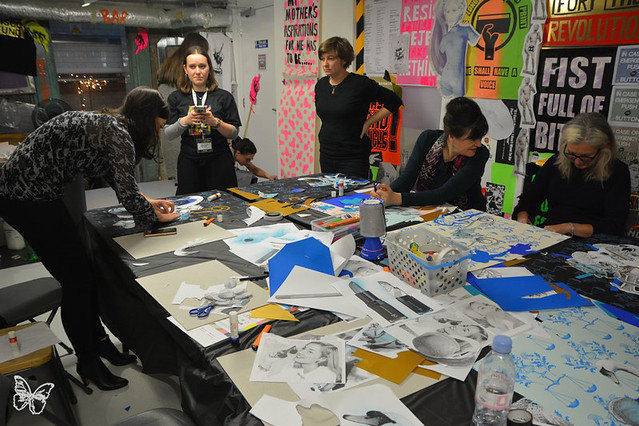
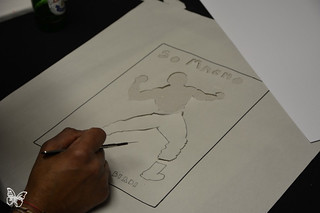
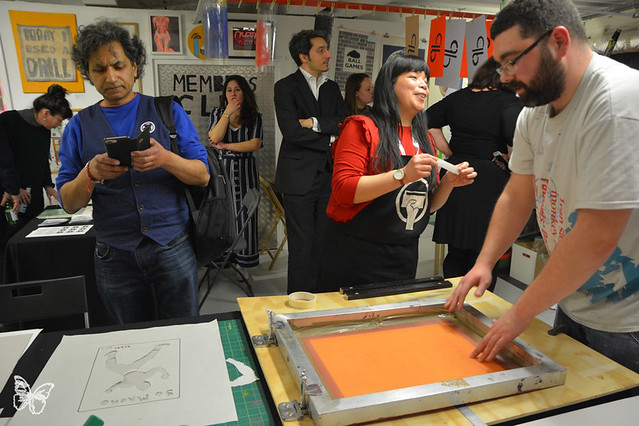
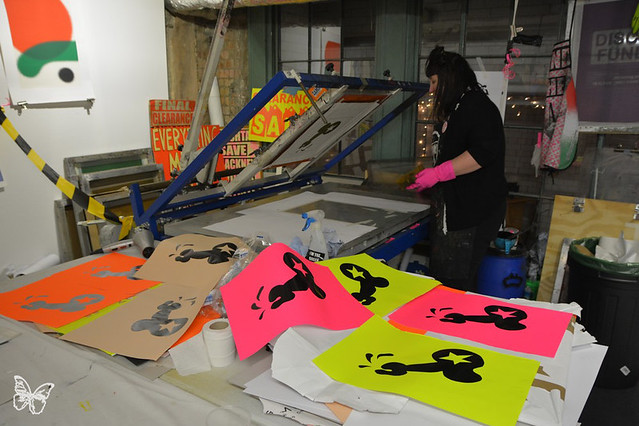
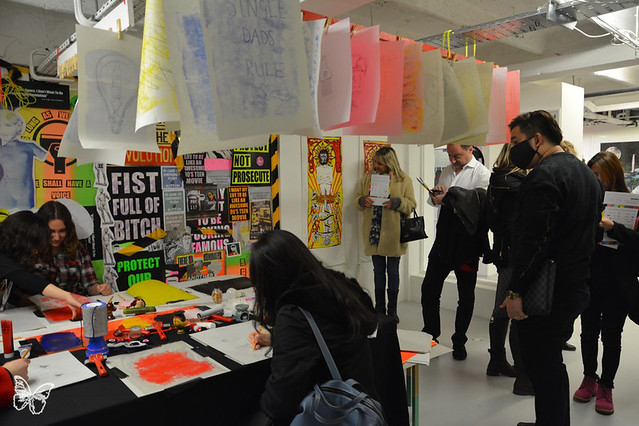
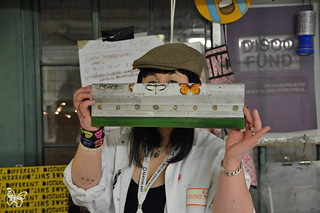
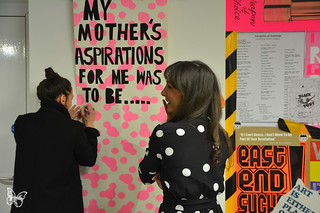
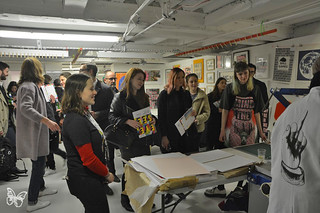
During the Other Art Fair in London, Aida Wilde (covered) and Sisters in Print held a series of workshops to share their skills and passion for printmaking, from cutting like a Ninja, print like a Butterfly to Macho only workshops.

Print is power - Sisters in Print

The workshops featured all the techniques from monoprint, stencils, collages, screenprints and tools of the trade and their secrets.

Print is power - Sisters in PrintPrint is power - Sisters in Print
Print is power - Sisters in PrintPrint is power - Sisters in PrintPrint is power - Sisters in Print

While the fierce ladies focussed on their techniques and prints with vibrant imagery and powerful slogans, men couldn’t help but cut a bold happy willy…
Expression in all its forms and good laughs were in order

Print is power - Sisters in PrintPrint is power - Sisters in Print Print is power - Sisters in PrintPrint is power - Sisters in Print

Big up to the energetic Queen Printmaker Aida, Juliette Stuart and the Sisters in Print, as well as GFSmith papers, Great Art UK and Screentec for providing the prints!

Print is power - Sisters in Print
Print is power - Sisters in PrintPrint is power - Sisters in Print

Full set of pics HERE
 

The Crystal Ship 2018 in Ostend (BE)

The Crystal Ship is a contemporary art festival bringing art to the seaside in Ostend, Belgium.
For its third edition over fifteen international artists will create large scale murals and art installations using the City by the Sea as their canvas. The new artworks will be added to the existing fifty murals and interventions visible through the city, making it the biggest mural festival in Europe.

The official opening will take place on 7th April 2018 in Monacoplein, Ostend

2018 Participating artists include:
A Squid Called Sebastian (B) – Ben Slow (UK) – Colectivo Licuado (URU) – Dourone (FR) – Etam Cru (PL) – Gaia (US) – Icy & Sot (IR) – Jaune (B) – Joachim (B) – Johannes Verschaeve (B) – Matthew Dawn (B) – Milu Correch (AR) – Oak Oak (FR) – Telmo & Miel (NL) – Wasp Elder (UK) – Zoer x Velvet (FR)

Here are some pics of the 2018 invited artists we’ve met across our travels:


Gaia

Etam Cru - NuArt
Etam Cru

Crimes of Minds - Ben Slow
Ben Slow

Icy & Sot - NuArt
Icy & Sot


Jaune
Wasp Elder
Wasp Elder


Butterfly Art News
will be reporting live from Ostend in Belgium on the new murals and present exclusive interviews from participating artists.

So stay tuned for more details coming soon…

The Crystal Ship
7-8 April 2018
Monacoplein
8400 Ostend, Belgium

London: Fourth Plinth by Michael Rakowitz

Michael Rakowitz

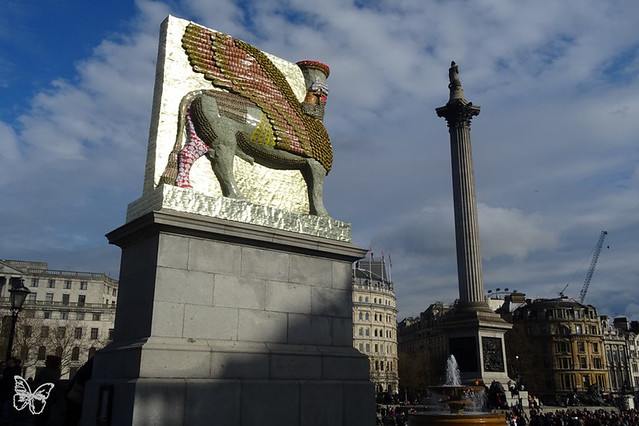
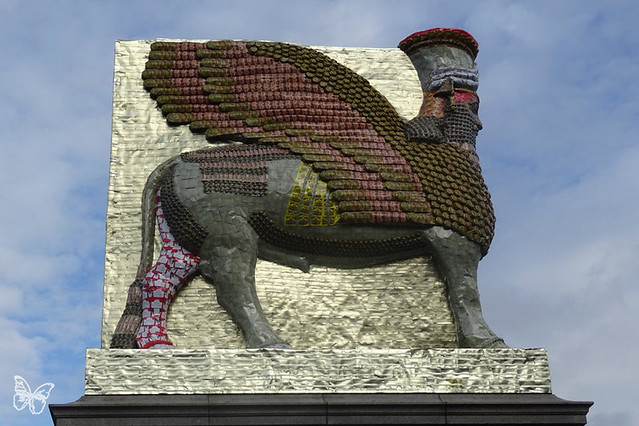
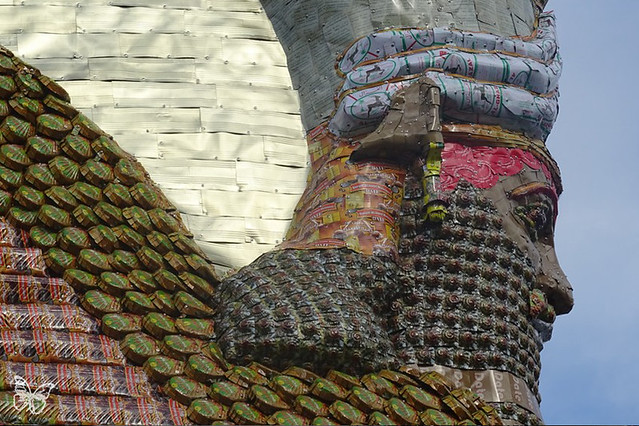
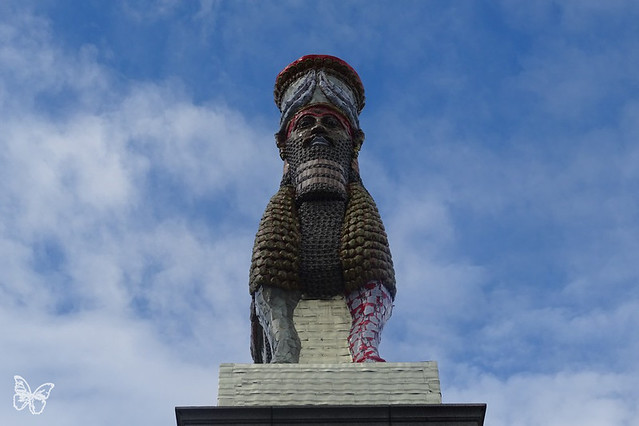
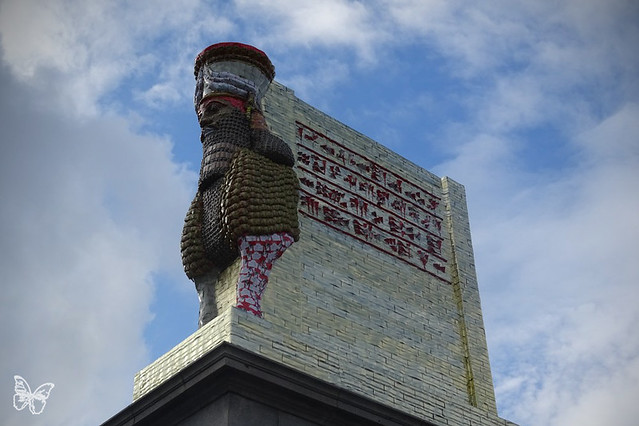
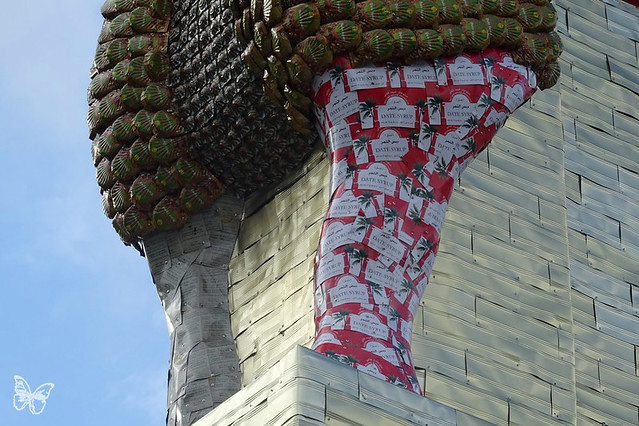
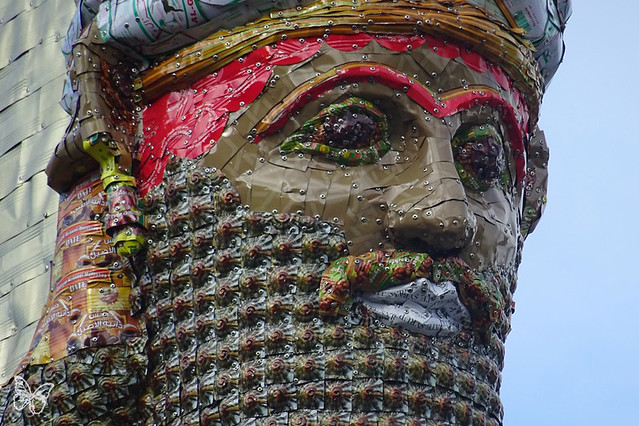
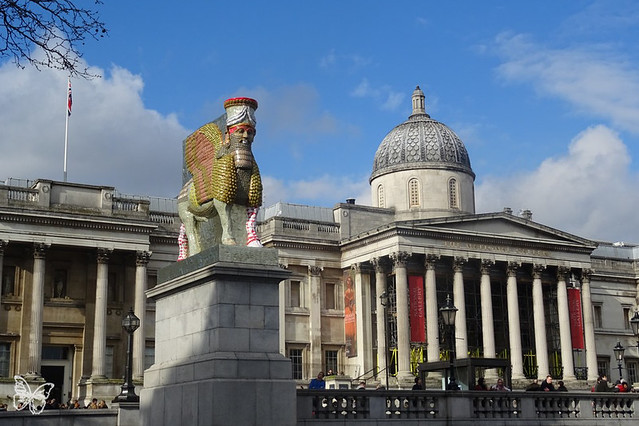
Following David Shrigley ‘ Really Good’ sculpture,  Iraqi-American artist Michael Rakowitz, has been selected to create the latest sculpture for the Fourth Plinth in Trafalgar Square using 9,000 tin cans of date syrup made in Iraq. The artwork is a reconstruction of the lamassu, a winged bull created around 700BC at the Nergal Gate of Ninevah, Iraq, nearMosul vandalised by Isis in 2015.

Michael Rakowitz has built an international art-world reputation over the past 15 years, fusing his autobiography as an American with an Iraqi-Jewish background with social and political observation and activism, as well as the odd absurdist link to pop culture.

During a family visit to the British Museum when he was aged 10, he recalls his first encounter with an Assyrian lamassu, like the winged bull only with a lion’s body. “Suddenly I found myself immersed in this space that was unlike any I had seen before,” Rakowitz recalls, “which was going past those lamassu and going into the throne room reconstruction from Nineveh and seeing the lion hunt of Ashurbanipal.”

Michael Rakowitz

The lamassu on the plinth is not a one-off but part of another long-term project, also called The Invisible Enemy Should Not Exist. For this, Rakowitz is reconstructing the entire database of 7,000 works looted from the National Museum of Iraq in the aftermath of the US and UK’s 2003 invasion. All of the reconstructions are made from Middle Eastern foodstuff packaging and local Arabic newspapers.

The project grew from Rakowitz’s observation that the sack of the museum was the first event of the war about which there was a consensus. “It didn’t matter if you were for the war or against the war, this was a catastrophe,” he explains. “But that outrage about lost artefacts didn’t turn into an outrage about lost lives.”

He noted that many looted artefacts were votive statues. “One of the interpretations of those artefacts is that those were statues that the ancient Babylonians, the Mesopotamians, would bring with them to the temple of the god, and the idea was that you would leave the sanctuary at a certain point but you left that statue in your stead, as a surrogate for you, to continue praying. And when I saw the artefacts being looted, I said, ‘Well, now we have another surrogate: a lost artefact for the lost bodies’. All those things loop back into the human and environmental catastrophe.”


Michael Rakowitz
Michael Rakowitz

Rakowitz was already thinking about reconstructing the lamassu after seeing the footage of it being destroyed by IS. He had discovered its measurements by referring to the sketches of Austen Henry Lanyard, the British archaeologist who discovered the lamassu and brought two others to the British Museum — the ones Rakowitz had seen as a child. He was invited by the Fourth Plinth organisers to submit a proposal and remarkably, the plinth was the same length as the lamassu — 14ft. “I was like, ‘This is it!’ What else would I do?”

Michael Rakowitz

Instead of merely recreating the sculpture, the artist wanted to recreate the DNA of Iraki people who got killed as well, so he decided to use date syrup cans.

So why date syrup cans? Rakowitz first began working with them in a New York project in 2006, Return, in which he reprised his grandfather’s import/export business but attempted to deal only in Iraqi goods. He had found the date syrup in a grocery store in Brooklyn but it was labelled “product of Lebanon”. In fact, the syrup was made in Baghdad, put into large plastic vats, driven to Syria and canned there before moving over the border into Lebanon, where it was labelled and sold globally. That way, sanctions were circumvented and, post-2003, security tariffs avoided. But for Rakowitz the journey was another metaphor, of course: the dates travelled “the same exact path as Iraqi refugees”.

Michael Rakowitz

Iraqi dates “were considered the best in the world; what the cigar is to Cuba”, he says. But their demise reflects the tragedy of Iraq’s recent history. Date palm trees disappeared, “from 30 million in the Seventies, when Iraq was the chief exporter of dates in the world, to 16 million at the end of the Iran-Iraq war [1980-88], to three million at the end of the 2003 invasion,” he says.

Michael Rakowitz

So the plinth sculpture reflects a huge sweep through Iraqi history. “It’s telling the story of a destroyed Iraqi artefact, and what it’s made from is telling the story of a destroyed land, destroyed nature, destroyed ecology,” he says. “And the destruction of a symbol that was so elemental to the Iraqi people. Dates are the harbinger of good things to come: you put a date into the mouth of a baby in some places in Iraq so its first taste of life is sweet. And when you have the erosion of that sweetness, it’s not a good omen.”

This is the genius of Rakowitz’s sculpture: it is history, art history, social history and current affairs. Rich knowledge and impassioned polemic all bundled into a single, glorious yet poignant symbol looking over Trafalgar Square.

Michael Rakowitz

View the full set of pics here

Michael Rakowitz
The Invisible Enemy Should Not Exist
from 28 March 2018
Fourth Plinth
Trafalgar Square,London

Paris: INTI ‘Profane’ at Galerie Itinerrance

Inti - Profane

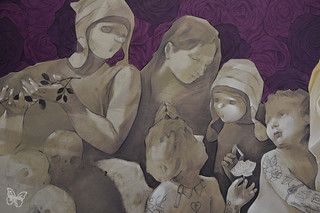
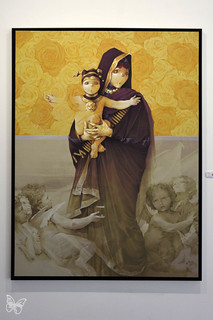
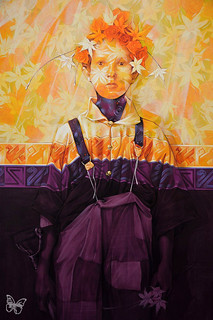
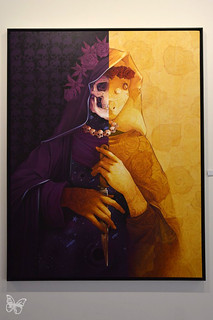
Chilean artist INTI retuns to Paris for a third solo show called ‘Profane’ at Galerie Itinerrance, featuring new paintings and an impressive site specific installation.

For years Inti kept on traveling all around the world to paint murals . His wall paintings often show the Kusillo, a character originated from the south-american carnival, or figures coming from religious imagery. These intense creations organized through rich and meaningful compositions allow him to approach social issues. The artist draws symbols from different cultures and various fields, he takes them out of their context to give them a new meaning by juxtaposition.

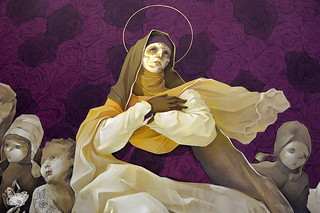
For «Profane», Inti selected a dozen of his murals he recently executed across the world from Lisbon to Miami and China. Based on the subjects represented on each of them, he adapted his artistic practice to the size of the canvas and changed some elements to better clarify his intention.

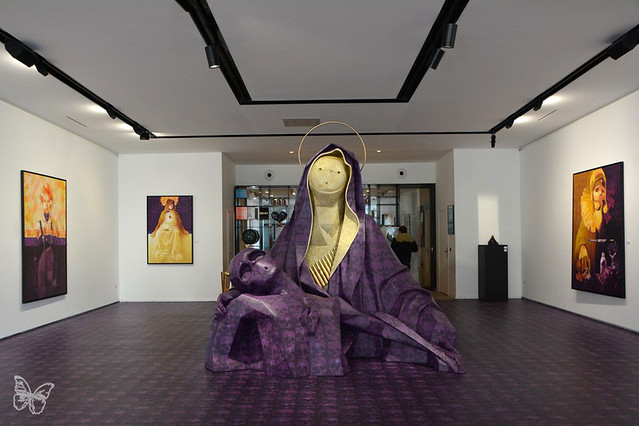
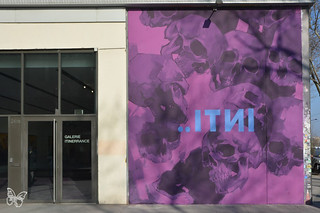
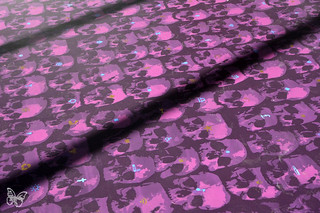
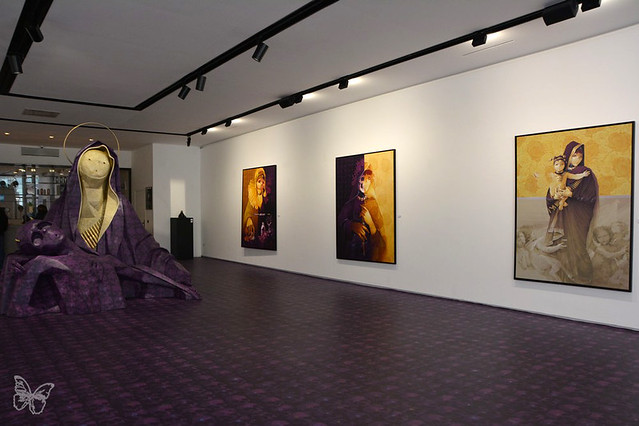
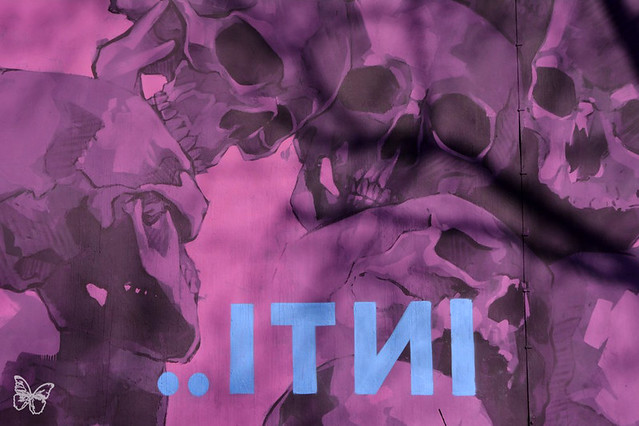
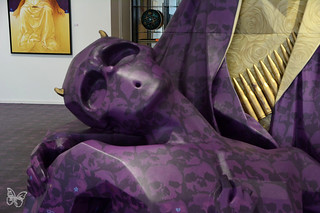
Inti also created an immersive installation by covering the floor with stencilled skulls while a spectacular Pietà sit prominently in the center of the gallery space.

Inti - ProfaneInti - Profane
Inti - Profane
Inti - ProfaneInti - Profane

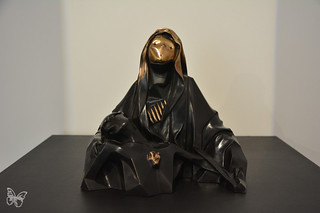
This 8.5 feet high installation is the result of a long work for Inti who experimented with a new medium. It took him 6 months of work and 12 hours a day to finish it. Beyond a technical challenge, Inti managed to represent in volume a traditional figure of religious iconography and reappropriated it with his own codes.

Inti - ProfaneInti - Profane
Inti - Profane

Through this new body of work, Inti addresses various issues , like the conflicts between science and religion, with a critical eye without expressing a definitive answer. The same way he spreads numerous iconography and symbols in each of his paintings, he injects in his compositions a multitude of elements and leave the spectator free to interpret them. «Profane» transcribe very well the journey Inti experienced since his last exhibition. His numerous travels can be felt through his openness to the world and his sensitivity.


Inti - ProfaneInti - ProfaneInti - Profane
Inti - Profane

«Profane» challenges us to reflect on the banality of our beliefs and dogmas, as opposed to the delicate, ephemeral and natural beauty of life.‘ – Inti

Inti - Profane

View the full set of pics here

Inti – ‘Profane’
Until 31 March 2018
Galerie Itinerrance
24bis boulevard du Général Jean Simon
75013 Paris